Weekly Data


WHAT THE DATA SAY: 56% of CEOs say their organizations aren’t speaking up enough on issues
By: Ray Day
CONTACT:
We wanted to share our latest consumer and business insights, based on research from Stagwell and Allison Worldwide. Among the highlights of our weekly consumer sentiment tracking:
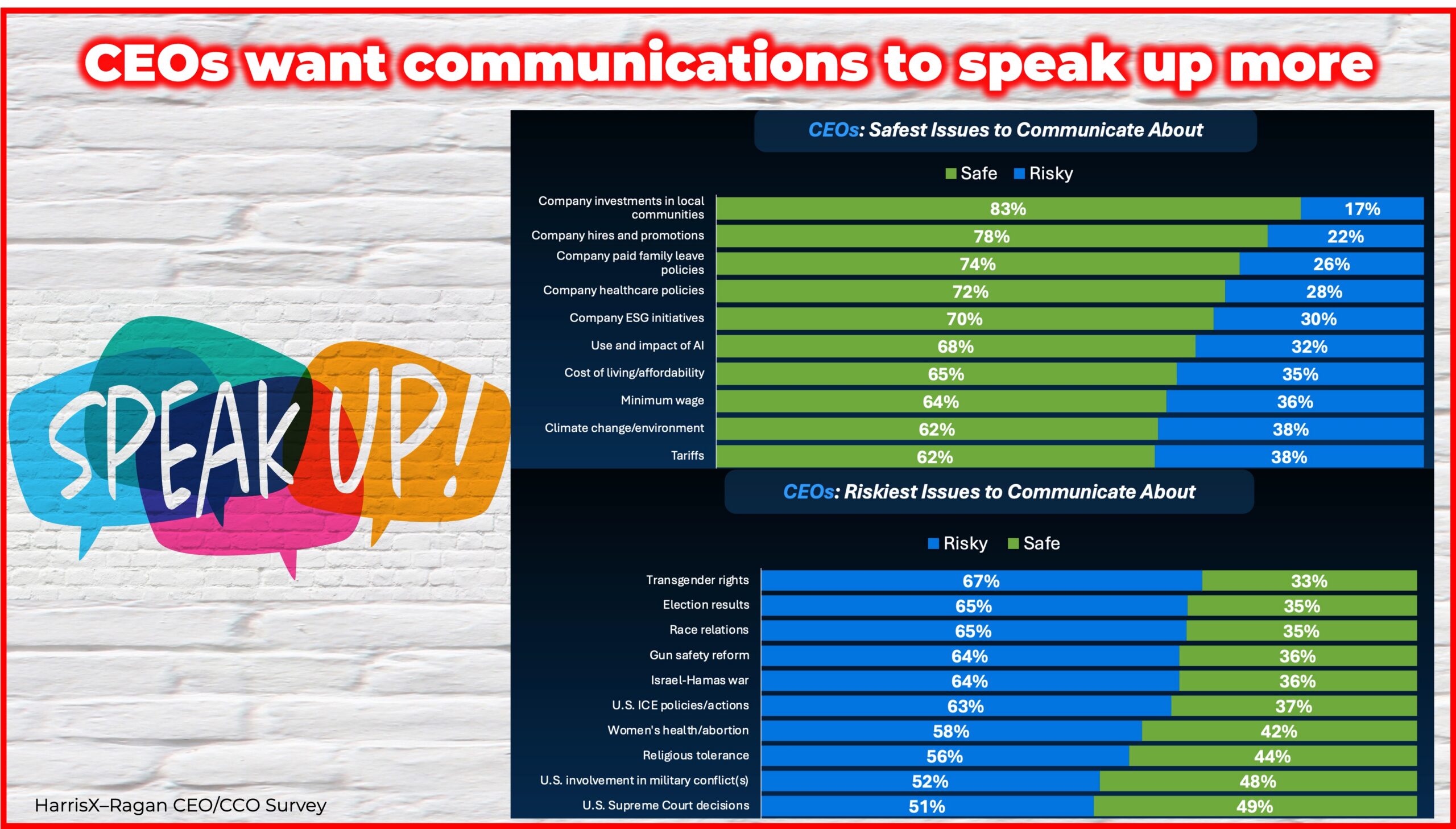
CEOs WANT COMMS TO SPEAK UP MORE, WITH MORE HUMANITY
CEOs want their organizations to speak up more and add more humanity in communications, according to the sixth annual survey of CEOs and communications leaders from HarrisX and Ragan.
- 56% of CEOs say their organizations aren’t speaking up enough on issues, up from 42% in 2025 – when 58% said they were speaking up too much.
- CEOs see company community investments (83%), hires and promotions (78%) and paid family leave policies (74%) as safe topics to discuss.
- Transgender rights (67%), election results (65%) and race relations (65%) are seen as risky topics to discuss as a business.
- 95% of organizations use AI in communications, and 48% are actively investing in and integrating it, up from 40% last year.
- 75% of leaders say AI is largely delivering on its promise of faster, better and more efficient communications.
- 7 in 10 CEOs say great communications professionals are still needed in the AI era, just with new tools – up from 51% last year.
- More than half (52%) would trust a top-tier professional without AI support over a custom-trained AI tool to write an important speech.
- In a reputational crisis, 62% of leaders favor responding to set the record straight, even if doing so draws more attention.
- 63% say market research provides the clearest picture of an issue’s broader reputational impact.
- Yet, among organizations that have faced a crisis, 72% used social media metrics to guide the response, while only 35% used market research.
- See also: Midterms Underscore Capitalism’s Growing PR Problem
HEALTHCARE NEEDS A TRANSLATOR
Americans are struggling to understand healthcare information and see a role for AI in making it simpler – yet not for diagnoses – according to new research from The Harris Poll and Elevance Health.
- 82% say some part of healthcare information feels like a “foreign language.”
- 45% have made a healthcare decision they later regretted because they didn’t understand the basics.
- Nearly three-quarters have encountered a healthcare challenge, such as understanding insurance coverage or a medical bill.
- Only 27% of those with a health plan say they completely understand it.
- 82% wish they could secure healthcare answers as fast as they can order food delivery through an app.
- 83% want an easy way to receive personalized healthcare recommendations based on factors such as their insurance, health needs and financial situation.
- 79% believe AI can improve healthcare experiences overall, yet only 20% currently use it as a regular healthcare information source.
- 72% would trust AI to accurately provide at least one type of healthcare information. However, trust varies by task: 33% trust it to explain insurance benefits, 30% to estimate healthcare costs and 13% for a diagnosis.
- See also: A doctor’s office or on-call doctor are considered a trusted resource by 81% of Baby Boomers but just 39% of Gen Z
CREDIT FOR CHRISTMAS
More Americans expect to need credit to cover monthly expenses heading into peak holiday shopping season, according to NerdWallet’s November Consumer Financial Resilience Index, conducted by The Harris Poll.
- 41% expect to rely on credit for at least some November expenses, up from 35% in September – a statistically significant 6-point increase.
- Millennials (57%) and Gen Z adults (52%) are most likely to need credit, compared with 39% of Gen X and 21% of Boomers.
- 58% of parents with children younger than 18 expect to rely on credit this month, versus 34% of Americans without minor children.
- About one-third lack a $1,000 emergency cash cushion.
- Despite rising credit needs, 77% feel in control of their day-to-day finances, and the same share are confident they can pay all their bills on time this month.
- 63% believe the U.S. economy will enter a recession within the next year, including 73% of millennials, 69% of Gen Xers, 59% of Gen Z adults and 52% of baby boomers.
- The overall Financial Resilience Index score stands at 60.9 out of 100, compared with 61.6 in October and 61.5 in September.
- See also: New Year, New Me Is Starting Before 2027
ICYMI: In case you missed it, check out the thought-leadership and happenings around Stagwell making news:
- Ray Day on Servant Leadership, AI, and Building Trust in Uncertain Times (Ray Day)
- The new American household CMO is 15 (Anne Colaiacovo, Allison, HarrisX)
- What can history teach us about AI (David Sable, Stagwell)
- Death by 1,000 handoffs: The hidden cost of AI friction (Stagwell Marketing Cloud)
Newsletter
Sign Up

Related
Articles
Weekly Data
Nov 19, 2026
WHAT THE DATA SAY: 56% of CEOs say their organizations aren’t speaking up enough on issues
In the News, Investments & Financials
Nov 13, 2026
Stagwell (STGW) Announces November and December Investor Conference Schedule

Weekly Data
Nov 13, 2026
WHAT THE DATA SAY: 52% plan to give to fewer people or buy fewer holiday gifts this year