By

Harris Brand Platform

Case Study Download

CONTACT

hello@stagwellglobal.com

SIGN UP FOR OUR INSIGHTS BLASTS

A Size-Inclusive Rollout Shrinks Earnings, but Not Brand Equity  

In August 2021, Old Navy launched BODEQUALITY, a campaign that expanded their clothing line to serve women sizes 00-30. Inventory mismanagement resulted in financial losses; however, Harris Brand Platform data shows that this “failure” comes with a silver lining:

  1. BODEQUALITY departed from the traditional women’s clothing market, with apparel specifically designed for curvy women and a strategy focused on size inclusivity.
  2. The right idea…Consumers familiar with the Old Navy brand appreciated BODEQUALITY’s mission, and the retailer’s brand equity hit a November high.
  3. …The wrong execution: Inventory mismanagement, and supply chain issues, resulted in stores overwhelmed with surpluses of the largest and smallest sizes, and a lack of their most popular mid-range sizes.

Download our case study to discover how consumers responded to Old Navy’s BODEQUALITY campaign, and how this “failure” also did the brand some good.

Related

Articles

Post Thumbnail
Post Thumbnail
Post Thumbnail

Newsletter

Sign Up

By: Ray Day

CONTACT:

Ray Day
ray.day@stagwellglobal.com 

We wanted to share our latest consumer and business insights, based on research from The Harris Poll, a Stagwell agency. 

Among the highlights of wave 139 (fielded Oct. 21-Oct. 23) in our weekly consumer sentiment tracking:

ECONOMY, INFLATION WORRIES REMAIN STEADY:

Today, 89% of Americans are concerned about the economy, inflation and jobs – the same high level as last week.

    • 85% worry about a potential U.S. recession (no change)
    • 82% about U.S. crime rates (down 1 point)
    • 75% about political divisiveness (up 1 point)
    • 74% about the War on Ukraine (no change)
    • 72% about affording their living expenses (down 1 point)
    • 61% about a new COVID-19 variant (up 1 point)
    • 47% about losing their jobs (no change)
    • 44% about the Monkeypox outbreak (down 4 points)
INFLATION IS AMERICA’S #1 STRESSOR:

How stressed are Americans, and what’s causing it? The answers are clear in the 2022 Stress in America survey we conducted with the American Psychological Association.

    • 27% of Americans report being so stressed that they cannot function most days.
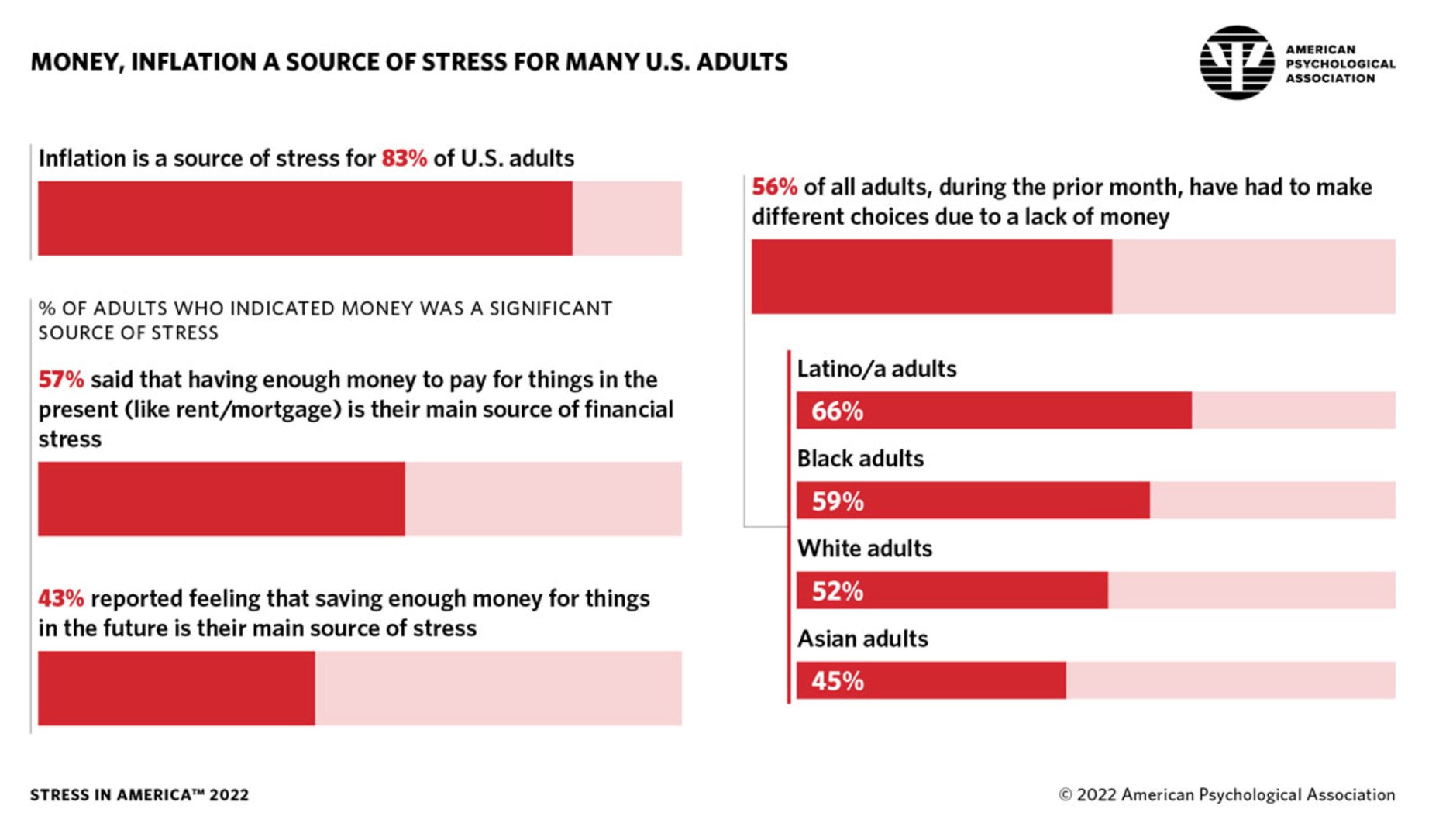
    • Inflation is the #1 stressor for 83% of adults. That is followed by violence and crime (75%), the current political climate (66%) and the racial climate (62%).
    • 76% say the future of the nation is a significant source of stress in their lives.
    • 68% say this is the lowest point in our nation’s history that they can remember.
    • 57% who indicated money was a worry said that having enough money to pay for things like food or rent/mortgage is their main source of stress.
    • 43% reported feeling that saving enough money for things in the future is their main source of stress.
    • 56% agreed that they and/or their family have had to make different choices due to lack of money in the past month, with Latino/a (66%) and Black Americans (59%) reporting this at a higher level than White (52%) and Asian (45%) American adults.
EMPLOYEES WARMING UP TO BACK-TO-OFFICE:

As we continue tracking return-to-office requirements, a majority of employees still say they will jump jobs if forced back to the office full-time. Yet the numbers of workers resisting return-to-office are much lower than three months ago, based on our survey with USA Today.

    • 57% of employed Americans say companies will lose employees if they require workers to be in-person (down 9 points from June).
    • 73% of remote and hybrid workers say they would find another remote or hybrid job if their company forced them to work from the office full-time (down 5 points from June).
    • In an earlier study with Bloomberg, 57% of workers said they believe that employers now have more power in the job market (a 5-point increase in favor of employers from January).
INFLUENCERS MATTER:

Nearly half of U.S. consumers consider input from influencers when purchasing a product or service – especially younger people, according to our survey with AdAge.

    • 80% of Gen Z consult user reviews before purchasing, and 75% say that recommendations from influencers affect their decision – nearly double the general population at 43%.
    • 40% of Gen Z members have made purchases directly through an influencer’s storefront on sites like Amazon and LTK.
    • 73% also report looking to TikTok creators for product input, with Instagram and YouTube influences being similarly popular choices.
BRANDS GETTING GEN Z RIGHT:

Beats by Dre, Jersey Mike’s Subs, Planned Parenthood, Lenovo and New Balance are doing the right things to capture the attention of Gen Z, according to the latest Ad Age-Harris Poll Gen Z brand tracker, a ranking of brands gaining the most attention from Gen Z members ages 18-24 in the third quarter.

    • Also doing better with Gen Z are Kickstarter, Impossible Foods, Coach, Flex Seal, Foot Locker, Pillsbury, Haagen-Dazs, Bose, Nature Valley, North Face, Crocs, NHL, Paramount, Fiji and State Farm.
    • See full details here.
ICYMI:

In case you missed it, check out some of the thought-leadership and happenings around Stagwell making news:

As always, if helpful, we would be happy to provide more info on any of these data or insights. Please do not hesitate to reach out.


Thank you.


Newsletter

Sign Up

CONTACT

hello@stagwellglobal.com

SIGN UP FOR OUR INSIGHTS BLASTS

Missed Advertising Week New York this week? We distill the biggest brand takeaways on brand fandom, political advertising, and media channel transformations below. Follow Stagwell on LinkedIn to keep up with the insights.

Rise of Brand Fandom – Move over, sports teams and celebrities. 

Fifty-seven percent of consumers consider themselves a fan of a brand or product – higher than sports (48%), movies (52%), celebrities (54%), or online influencers/personalities (37%). 

The brands that take a holistic stake in consumers’ lives will drive loyalty, affinity, and advocacy–and not just in the moment. Fandom is not a fad or a flash in the pan; 2 in 5 brand fans have been fans for over 10 years. Focus on helping consumers develop their personalities through your brand by delivering marketing, events and experiences, and content that gives them a platform to express that personality.  

“Fandom is critical in the luxury space. Luxury is no longer defined as the most expensive thing –it’s defined by insider knowledge. We’re seeing a dispersion of brands being considered ‘wealth’ and ‘luxury,’ and price point alone won’t keep you in that luxury equity space. It’s important to have fan bases that really think of your brand as luxury.” – Neda Whitney, SVP, Head of Marketing, Americas, Christie’s

Political is the Biggest Media Story of 2022 – Get ready for hotter cyclical media environments as political advertisers diversify digital media channels to engage more voters.

Brands will feel the effect of political messaging as political advertisers spend a record $3 billion in the last three weeks of the election alone.

Many ads will tell Americans they’re poorer than ever because of inflation, for example – how will brands push back and get consumers to continue spending? Brands can no longer afford to be apolitical but risk looking too performative if they don’t back up their positions with actions. Lyft decided to foreground its identity as a transportation company when deciding to act, and as a result, it has provided ride services for voting, vaccines, and reproductive rights.

“We saw in 2016 that so many people chose not to vote because they didn’t have access to transportation. So we asked ourselves: how can we make an impact there? We created a voter access program and saw its immediate impact in 2020. It’s about looking at the issues consumers care about and our services. It’s our job to listen – to talk to elected officials and let them know we can come in as a partner to solve some of the issues our consumers care about.” – Heather Foster, Head of Government Affairs, Lyft

Digital Channels and Political Advocacy – Are political advertisers about to have the digital marketing efficacy reckoning?

This cycle will be the first many realize media buys are not driving impact because of mistargeting. Many voters in battleground districts no longer have traditional television – but there’s a disconnect between ad spending and consumption, with most dollars still going to broadcast. Brands need to get more comfortable shifting the media mix and taking risks with bourgeoning digital channels.

“The idea that there’s the TV generation and then there’s the kids – it’s an antiquated view. The fact is cord cutting is mainstream – now the majority of the population – and the idea that we can say we have a TV strategy and a different digital strategy is fraught with disaster. As we iterate, brands need to think about messaging across the full funnel, and know that TV and streaming work really well together because it allows us to do that. The future will be integrated streaming and linear in a really incremental fashion.” – Ashwin Navin, CEO SambaTV

Resurgence of OOH – OOH is resurging because OOH is modern.

When you start treating it like programmatic or digital it becomes a valuable tool in the funnel. Driving consumer engagement and social amplification through use of the OOH medium. (The Harris Poll found TikTok and other social media platforms are a major source of OOH ad visibility: 82% of TikTok users report frequently noticing OOH ads in content in their feeds, with nearly identical impact reported by Facebook and Instagram users.) And don’t sleep on the innovation underway here: location-based insights, shared AR capabilities, and more are all letting advertisers do more at scale. Embrace the underlying technology capabilities of Out of Home as a resilient pillar of your media plan for 2023.

”Out of home isn’t changing – the strategy is. Media is the new experiential and Out of Home is where people are. The technology that sits behind Out of Home is driving a different strategy lens, a different creative lens, and a different content lens.” – Brad Simms, CEO, GALE Partners.

Related

Articles

Post Thumbnail
Post Thumbnail
Post Thumbnail

Newsletter

Sign Up

Originally Released On

PR Newswire

CONTACT:

Sarah Arvizo
Stagwell
pr@stagwellglobal.com 

Epicenter Experience is Stagwell Marketing Cloud’s 3rd Acquisition in 2022, Adding Mobile and Location Data to its Evolving Data and Insights Stack

NEW YORK and BOSTON, Oct. 19, 2022 /PRNewswire/ — Stagwell (NASDAQ: STGW), the challenger network built to transform marketing, has acquired Epicenter Experience (Epicenter), an enterprise software company that leverages mobile and location data to map and sequence complex consumer behavior patterns. Epicenter will become part of the Stagwell Marketing Cloud (SMC), a proprietary suite of software-as-a-service (SaaS) and data-as-a-service (DaaS) products built for in-house marketing teams.


“We have strong momentum building around the Stagwell Marketing Cloud’s insights and analytics capabilities, and we’re excited to add Epicenter’s location-focused platform as another supplement to our data stack,” said Stagwell Chairman and CEO Mark Penn. “With this AI-powered technology, we can deliver more comprehensive data intelligence to brands, helping them more effectively drive customer acquisition and retention goals.”

“With The People Platform we’ve built a tool that provides contextual awareness and behavioral understanding on a granular level, providing our clients with a connective tissue that they’ve come to view as a ‘currency service.’ We look forward to enhancing the SMC with this technology that can be applied within any industry,” said Epicenter Experience CEO and Co-founder Paul Krasinski. “Through these direct-from-consumer learnings we empower our customers across retail, healthcare, consumer goods, sports, entertainment and more to create more valuable, more personalized connections to their audiences at scale.”

SMC has been actively investing in emerging technologies and data-focused platforms as part of its strategy to serve in-house teams with transformative marketing technology capabilities. This is the SMC’s third acquisition in the second half of 2022, following Apollo Program in July and Maru Group in October. Epicenter will continue to be led by its current leadership team including Co-founders CEO Paul Krasinski and CFO Lynne Lipinsky.

Terms of the deal were not disclosed.

About Stagwell

Stagwell is the challenger network built to transform marketing. We deliver scaled creative performance for the world’s most ambitious brands, connecting culture-moving creativity with leading-edge technology to harmonize the art and science of marketing.  Led by entrepreneurs, our 13,000+ specialists in 34+ countries are unified under a single purpose: to drive effectiveness and improve business results for their clients. Join us at www.stagwellglobal.com.

Newsletter

Sign Up

By: Ray Day

CONTACT:

Ray Day
ray.day@stagwellglobal.com 

We wanted to share our latest consumer and business insights, based on research from The Harris Poll, a Stagwell agency. More from The Harris Poll is available at this link.

Among the highlights of wave 137 (fielded Oct. 7-Oct. 9) in our weekly consumer sentiment tracking:

  • JOB, COST-OF-LIVING WORRIES UP AGAIN: Today, 86% of Americans are concerned about the economy, inflation and jobs – moderating from last week. Yet worries about affording living expenses and losing a job are on the rise again.
    • 86% are concerned about the economy and inflation (down 4 points from last week)
    • 82% about a potential U.S. recession (down 4 points)
    • 81% about U.S. crime rates (down 1 point)
    • 73% about political divisiveness (down 1 point)
    • 73% about affording their living expenses (up 1 point)
    • 73% about the War on Ukraine (no change)
    • 57% about a new COVID-19 variant (down 2 points)
    • 48% about losing their jobs (up 3 points)
    • 47% about the Monkeypox outbreak (up 2 points)
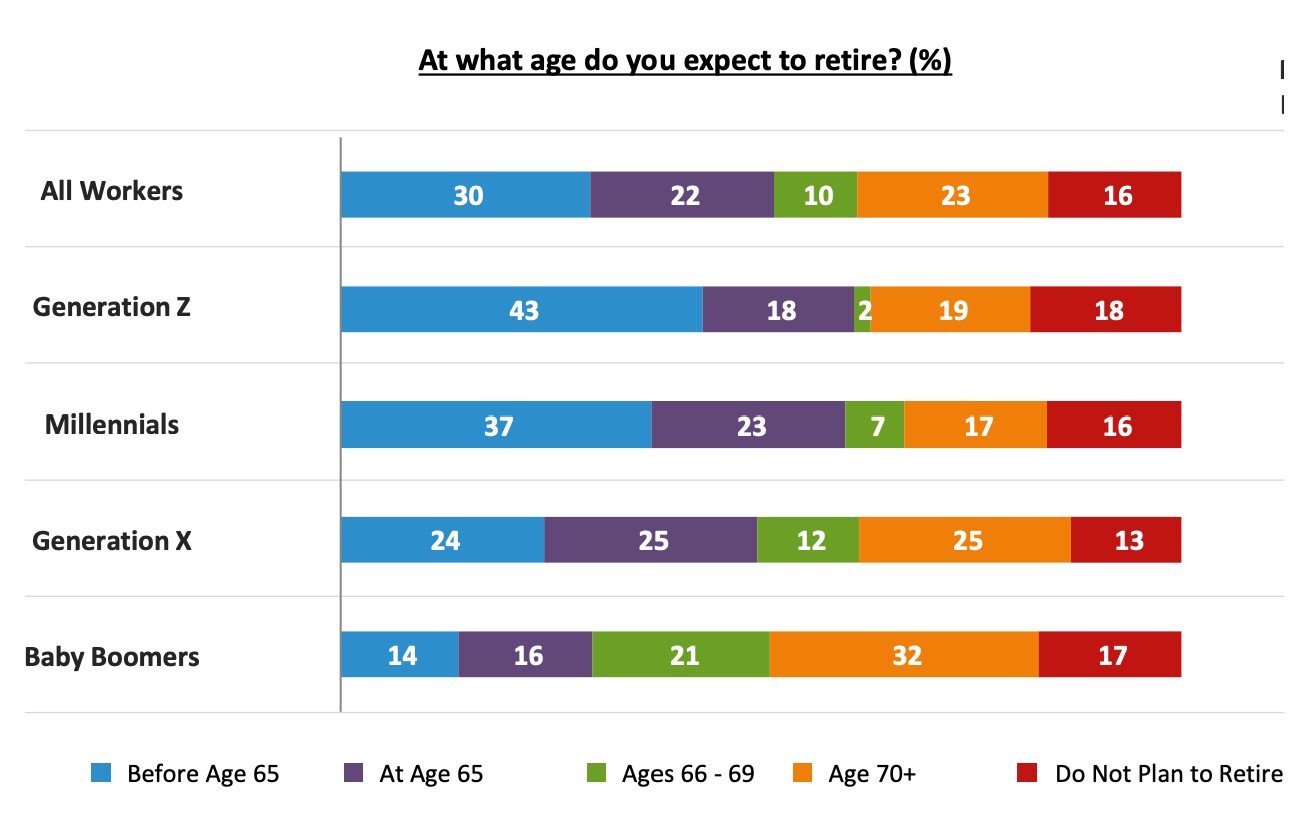
  • GEN Z NOT BANKING ON SOCIAL SECURITY: Of the four generational groups currently in the working world, Gen Z is the least likely to depend on Social Security to fund their retirement – and the most likely to retire early. That’s according to the “Emerging From the COVID-19 Pandemic: Four Generations Prepare for Retirement” survey released this week with the Transamerica Center for Retirement Studies.
    • Gen Z workers (43%) are more likely than older generations to expect to retire before age 65 (versus 30% of all workers expecting to retire before age 65, 37% for Millennials, 24% for Gen X and 14% for Baby Boomers).
    • 67% of Gen Z workers are saving for retirement through employer-sponsored 401(k) or similar retirement plans or outside the workplace.
    • The median age at which Gen Z is starting to save – 19 years old – is much younger than the median starting age for Millennials (age 25), Gen X (30) and Boomers (35).
    • Among Gen Z and Millennials, 73% said they are concerned that Social Security will not be there when they are ready to retire.
    • That compares with 40% of Boomers who expect Social Security to be their primary source of retirement income.
    • Gen X workers have the least faith in Social Security, with 78% saying they are concerned that Social Security will not be there for them when they are ready to retire.
  • HIGH SCHOOLERS WANT MORE CAREER HELP: High school students across the country are frustrated with the lack of support they are receiving in preparing for a future career. Our survey with the Data Quality Campaign and Kentucky Student Voice Team found:
    • 54% say the pandemic has changed how they think about what they might do after graduation.
    • Only 35% say their school informed them of which postsecondary or career paths are available to them.
    • 80% of students agree they would feel more confident about their career path if they had better access to information to determine their options after graduation.
    • This lack of career preparation already is showing up in the workplace. Of Gen Z members who interned or started a job this past year, 49% say that they did not feel like their training and onboarding were done well.
    • 58% of interns also report feeling lost at work without anyone to reach for questions and support.
  • LESS THAN HALF OF VOTING AMERICA WATCHES TRADITIONAL TV: When it comes to reaching Americans this election season, less than half of voters (49%) have a traditional TV, according to a new HarrisX survey with Samba TV.
    • 1 in 4 of those who do still have traditional TV plan to cancel in the next six months.
    • Independents (42%) are the least likely to have traditional TVs.
    • Millennial and Gen Z voters are more than twice as likely to stream than they are to have a traditional linear subscriptions today. The gap is even wider for younger voters in battleground states.
    • Facebook remains the most used platform by registered voters nationally but has less of an impact in key battleground states.
    • Democrat voters are significantly more likely to use TikTok than Republicans nationally –with 37% of Democratic voters using it weekly compared with 27% of Republican voters.
  • MANY WOMEN STILL MISS DEADLY BREAST CANCER SIGNS: October is National Breast Cancer Awareness Month, and most women are unaware of the unusual symptoms of a particularly aggressive and deadly form of the disease, according to our survey with The Ohio State University Comprehensive Cancer Center.
    • The good news: 78% of women recognize a lump in the breast as a sign of breast cancer.
    • However, less than half of women would flag redness of the breast (44%), pitting/thickening of the skin (44%) or one breast feeling warmer or heavier than the other (34%) as possible symptoms of breast cancer – specifically the rare and highly aggressive form of the disease known as inflammatory breast cancer.
  • ICYMI: In case you missed it, check out some of the thought-leadership and happenings around Stagwell making news:

As always, if helpful, we would be happy to provide more info on any of these data or insights. Please do not hesitate to reach out.

Newsletter

Sign Up

Originally Released On

PR Newswire

CONTACT:

Sarah Arvizo
Stagwell
pr@stagwellglobal.com 

SMC’s second acquisition integrates SaaS platform linking global behavioral, transactional and attitudinal data

Maru brings new, global capabilities to SMC. Maru’s SaaS solution, HUB, is a fully scalable survey platform that allows in-house marketers to analyze behavioral, transactional, and attitudinal data all in one place. With tens of millions of survey completes processed a year, the Maru/HUB platform manages research from ad-hoc studies to global trackers. Partnerships with 14 vetted sample partners worldwide allow Maru to connect clients with expertly profiled respondents.  


“Stagwell is pleased to add this sophisticated ‘research as a service’ partner,” said Mark Penn, chairman, and CEO, Stagwell. “Maru will be a great addition to our Stagwell Marketing Cloud and round out our research offering from full-service analytical to do it yourself. Maru is research built for enterprise scale but in simple, convenient and affordable ways.” 

“From full service to self-service, SMC believes marketers need to integrate connected technologies to stay ahead and drive business growth in the modern digital economy. This acquisition demonstrates our commitment to that belief,” said Elspeth Rollert, chief marketing officer, SMC. “We pride ourselves on a commitment to entrepreneurs like Ged Parton who are building the future of connected brand ecosystems, and we’re thrilled to have the Maru Group team join SMC.” 

Maru strengthens SMC’s global, blue-chip client list and presence including Buenos Aires, Chicago, London, Los Angeles, New York, San Francisco, Southampton, Toronto, and Vancouver.  

“Maru’s suite provides real-time access to insight and results, bringing into one ecosystem adaptive interpretation of behavioral, transactional, and attitudinal consumer data,” said Ged Parton, CEO, Maru Group. “By joining SMC, we’re scaling our services to some of the fastest-growing brands worldwide and translating our belief that understanding the intersection between behavior and emotion is critical to establishing the strongest possible consumer connection to drive better business results.”  

Maru joins SMC as its second acquisition amid an accelerated focus on technology-based marketing innovation from parent company Stagwell. In July 2022, SMC acquired Apollo Program.  

SMC’s leadership team is growing with the appointment of former Accenture Applied Intelligence Practice lead Mansoor Basha as chief technology officer. Mansoor joins Matthew Lochner, managing director; Abe Geiger, chief product officer; and Elspeth Rollert, chief marketing officer.  

Products across the suite are picking up momentum, too, as marketing professionals race to integrate technology. In August 2022, ARound – a shared augmented reality solution for live events  – launched in partnership with the Minnesota Twins, bringing the world’s first stadium-level shared A.R. experience to life. Further, PRophet, Stagwell’s AI-powered tool for predicting the success of media pitches, has launched “2.0” enhanced by partnerships with PeakMetrics, Podchaser, and The Harris Poll. 

Stephens Inc. served as advisor to Maru Group. Terms of the deal were not disclosed. 

About Stagwell  

Stagwell is the challenger network built to transform marketing. We deliver scaled creative performance for the world’s most ambitious brands, connecting culture-moving creativity with leading-edge technology to harmonize the art and science of marketing. Led by entrepreneurs, our 13,000+ specialists in 34+ countries are unified under a single purpose: to drive effectiveness and improve business results for their clients. Join us at www.stagwellglobal.com.  

Newsletter

Sign Up

By Mark Penn 

CONTACT

hello@stagwellglobal.com

SIGN UP FOR OUR INSIGHTS BLASTS

Quick, tell me when your state’s primary was. Odds are, most Americans can’t.

Seems like democracy is much threatened these days, and yet no one seems to care much about voting in the most important elections in the country – the primary elections. While turnout has surged in general elections, up to 67% in the last presidential race, it has gone nowhere in primary elections, with most getting between 20% and 40% of voters to the polls. But there are simple reforms that could go a long way toward fixing the primary problem.

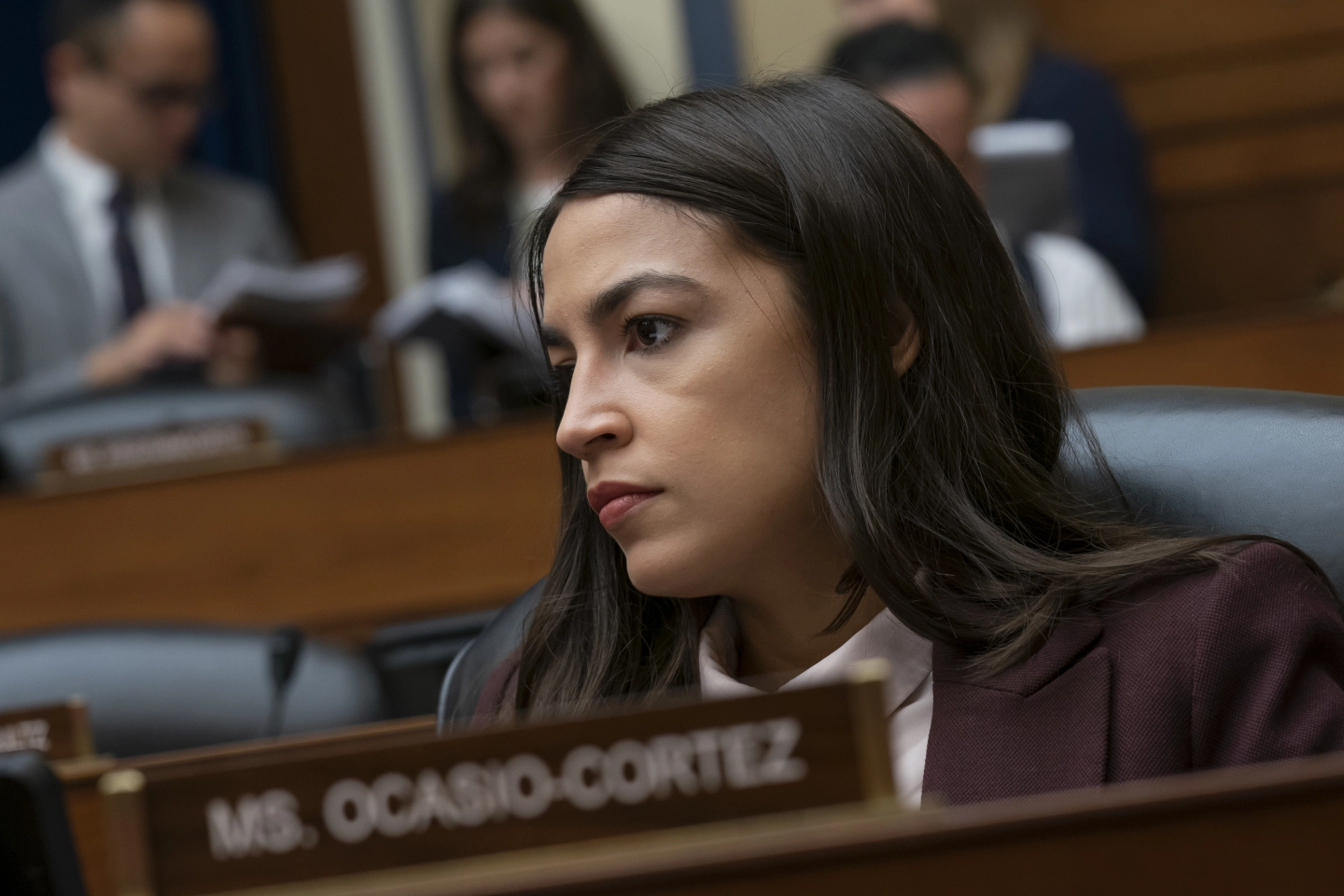
As more and more of the country is one-party territory, these primary elections really determine who governs in America and sets the ideological makeup of our leaders. Alexandria Ocasio-Cortez, one of the most outspoken members of Congress and a leader of the “squad,” was elected with fewer than 17,000 votes in a Congressional district that has nearly 700,000 people. She was able to win by mobilizing a small number of activists while the average voter was sleeping. Turnout among eligible Democrats in that key race was 13%, similar to many primaries across the country. Even in this year’s hotly contested primary for squad member Ilhan Omar, only 27% of the voters turned out.

Not only are primaries scattered over 20-odd dates from March to September, but the big money flows to partisan efforts that operate under the guise of being nonpartisan. Many nonprofit civic groups today are just taxpayer-funded partisan efforts to register voters in favorable areas or redistrict for the benefit of one party. Former Democrat Attorney General Eric Holder’s National Redistricting Foundation uses litigation to challenge gerrymandering, but seemingly only where it hurts Democrats. Youth registration–focused Rock the Vote claims to be nonpartisan, but its president released a statement explicitly lamenting Trump’s 2016 victory. Donors simply care more about who wins rather than about making the process more open, fair, and democratic, letting the chips fall where they may.

In a slew of swing-state Senate primaries in May 2022 for elections that will likely determine control of Congress, well under half of eligible voters participated. While an estimated 60% of eligible Georgians voted in the January 2021 runoffs that won the Democrats the Senate, just 27% participated in the May 2022 primary for one of those seats. Herschel Walker won the Republican nomination by receiving 800,000 votes in a state of 7 million active voters. In Ohio, only 20% of eligible voters participated in the Senate primary in which J.D. Vance cleared the Republican field. In both Georgia and Ohio, voters can participate in any party’s primary.

Things were only slightly better in Pennsylvania’s Senate primary, where 32% of eligible Democrats and 39% of eligible Republicans chose progressive John Fetterman and Dr. Mehmet Oz, respectively, over more moderate alternatives in a state that is divided quite evenly.

And these are the turnout numbers in high profile races. An abysmal 13% came out to the New York Democratic primary for governor, where Andrew Cuomo’s replacement Kathy Hochul ran for her first full term.

Low primary turnout facilitates the rise of more extreme candidates who could not otherwise be elected by a full constituency. Those who vote in primaries, especially on the right, are more strongly partisan and ideological than other Americans, according to the Brookings Institute’s 2018 Primaries Project.

Less well-known but still powerful positions like district attorney are especially vulnerable to activist candidates in a low-turnout environment. For years, left-wing billionaire George Soros has quietly given millions to “reform-minded” DA candidates, including new Manhattan District Attorney Alvin Bragg. Now in charge of the criminal justice system of the nation’s largest city, Bragg won his office last year in an eight-way Democratic primary that attracted just 250,000 voters, or 29% of the eligible population.

Nonpartisan primaries in which all candidates run on the same ballot may encourage moderation, but they have not solved the turnout problem so far. In Alaska, Senator Lisa Murkowski, the only Republican who voted to convict Trump of impeachment and is facing reelection this year, has survived a Trump-backed challenger so far only because the open primary allowed them both to advance to the general election. Yet just 26% of eligible Alaskans participated. Similarly, the only two Republican representatives who voted to impeach Trump and have survived their 2022 GOP primaries both did so in top-two systems, where the ballot includes all candidates regardless of party. Yet turnout was still low – 19% in California Congressman David Valadao’s district and 37% in Washington Congressman Dan Newhouse’s.

So with all of the hullabaloo over every single placement of a drop box, there is no outcry about how American democracy has been undermined with confusing, little-known primary schedules that favor activists on both sides.

To fix these problems we need to take some urgent steps. First, we need to shine light on this low participation and information as a problem. Second, we should deny tax deductibility status to nonprofits that are carrying out one-party agendas and encourage the growth of nonprofits that want high voter participation in all elections by all voters. Third, we need to set three or four regional primary days in which groups of states all hold their primaries at the same time to cut down on all the confusion of 20 or more possible dates. Further complicating this are Democratic campaigns to meddle with the primary process by deliberately providing tens of millions of dollars to extreme candidates they oppose and hope will be easier to defeat in the general election. Though unlikely to be banned outright, this practice further undermines the primary process, and hopefully the parties will agree to end it in the name of a fair democracy.

More extreme candidates are increasingly winning political office across every level of the country well before Election Day, with the input of just a fraction of eligible voters. If calls for higher turnout are really about strengthening democracy, primaries deserve a lot more focus. The current trend of Americans flocking to general election polls but not primary ones suggests that those calls for turnout are more about partisanship than participation.

Mark J. Penn is the chairman and CEO of Stagwell Inc., the NASDAQ-listed challenger network built to transform marketing, and co-chair of the Harvard-CAPS Harris Poll. His career spans 40 years in market research, advertising, public relations, polling, and consulting. A globally recognized strategist, Penn has advised top world leaders, including presidents, led companies, and written two bestselling books.

 

Related

Articles

Post Thumbnail
Post Thumbnail
Post Thumbnail

Newsletter

Sign Up

By

Natalie Oganesyan
Yahoo! Entertainment

CONTACT

hello@stagwellglobal.com

SIGN UP FOR OUR INSIGHTS BLASTS

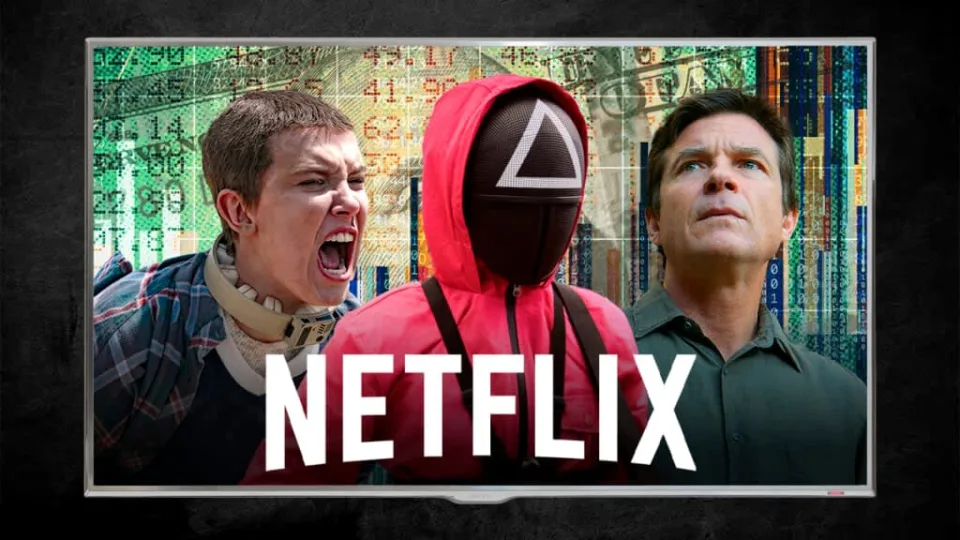
Nearly half of current Netflix subscribers (46%) would consider a shift to the platform’s ad-supported model once it’s available, according to a survey of 1,300 current users conducted by Samba TV and Harris X. The data collected also showcases that those willing to make the move tend to skew older and make less per capita, with Gen Z respondents being the least interested (at 38%) in making the switch.

As previously reported this month, the embattled streamer has plans to launch its ad-supported pricing tier in November, ahead of competitor Disney+’s own ad-supported model debut in December. Additional details on pricing have not yet been announced, but TechCrunch estimates that the cost could fall between $7 to $9. (Currently, basic Netflix plans are $9.99 a month, with standard and premium pricing at $15.99 and $19.99, respectively.) Despite mixed opinions on the matter, the data gathered by Samba TV and Harris X indicate that the tier will not present a risk to the company.

Roughly half of Netflix users (45%) said they would consider switching to a tier discounted by half of what they currently pay as long as ads totaled five minutes or less per hour. More than half (51%) would deliberate the shift should the service be free (an unlikely scenario).

A further breakdown by age and income illuminated that a majority of Boomers (52%) and almost half of Millennials (48%) would be interesting in shifting to the ad tier, whereas Gen Z, who have more or less grown up on ad-free streaming, are less inclined to do so. Additionally, a majority of those making under $75,000 expressed an interest in moving to the tier as opposed to less than half (42%) of those making over that amount.

The ad tier also opens up the avenue for Netflix to bring in more subscribers; nine out of 10 non-users already report watching ad-supported streaming content, with 1 out of 3 of them being under 35, according to a survey of 1,200 non-subscribers.

“The exciting value proposition from Netflix’s upcoming ad model lies in the possibility it offers to bring in net new or lapsed subscribers,” Samba TV CEO and co-founder Ashwin Navin said in a statement. “9 out of 10 adults who do not currently have a Netflix subscription watch other ad-supported content today, indicating these audiences have no aversion to watching ads in exchange for free or reduced price content and are prime candidates to turn to Netflix’s new ad-supporter tier.”

In all, Samba TV’s survey with the Harris polling firm collected data from over 2,500 U.S. adults from Aug. 29 through Sept. 1. The sampling margin of error of the poll is plus or minus 2.0 percentage points. The results reflect a nationally representative sample of U.S. adults, with results weighted for age by gender, region, race/ethnicity and income where necessary to align them with their actual proportions in the population.


Related

Articles

Post Thumbnail
Post Thumbnail
Post Thumbnail

Newsletter

Sign Up

By

Assembly on August 2, 2022


Originally released on

Assembly Global

Assembly’s in-house political strategy team is currently projecting a total cycle spend of $9 billion.

We’re here again, another political cycle. Is anyone else getting déjá vu?

If you’re a consumer, you might be feeling the urge to turn off your news updates and go into a political hibernation until it’s all over. But marketers get no such liberty. Why? Advertising spend is at an all-time high in the political sphere, political messaging is rampant, and your media dollars, and even, strategy are going to be impacted…we can guarantee it. Don’t believe us? The numbers speak for themselves…

Assembly’s in-house political strategy team is currently projecting a total cycle spend of $9 billion. And up to $3.3 billion of that will be spent in just a 5-week timespan. Yep, you read that right.  

Luckily for our clients (and anyone looking for expertise at the intersection of media, data, and politics), Assembly has a secret weapon: our political team and our proprietary Political Insights Dashboard, which tracks the who, what, when, where, & why of political advertising at the speed of politics itself.  

We sat down with one of our lead political strategists, Tyler Goldberg, to get an inside view of exactly what to expect this election season, plus some critical Rules of the Game in the political advertising landscape.  

But first…

Let’s set the stage for our political team, in case you’re wondering how we got here. Three years ago, Assembly placed the largest single media buy in history during the Mike Bloomberg for President Campaign. After dipping our toes – or rather – diving feet first into the political arena, we now pride ourselves on being a full-service political media agency, thanks to our in-house team of experts.  

Hear more from Tyler:


Now, let’s dig in some more…

Q: Political ad spending is pretty unprecedented, in the sense that, in such a short time span, there are more dollars in the market than perhaps ever. This happens with virtually no other verticals. Can you talk about what this means for the overall advertising landscape?

A: We’re projecting that close to $3.3 billion in political ad spending will occur between October 1, 2022, and November 8, 2022. To put this in perspective, if we combined the total media spend of any advertiser outside of political within that same 5-week timeframe, the numbers likely wouldn’t even come close. Given this, our job is to prepare advertisers for limited inventory, rising costs in certain markets, and setting them up to be nimbler and ready to respond to the changing landscape.  

Through the first half of the year, political spending is up 200% ($1.3 billion) over the 2018 election cycle and close to 20% ($433 million) over the 2020 presidential election.  

The fact that we’re already outpacing the most recent presidential election this season is astounding. From here, it’s estimated that spending will only continue to rise cycle over cycle. 


Another Rule of the Game you might not be aware of when it comes to ad inventory? TV advertisers, listen up: Within a 45-day window for a primary election and 60-day window for a general election, candidates must be offered the lowest unit rate (LUR). On the flip side, issues-based advertisers often pay premiums upwards of 50-200% higher than an average advertiser will during an election cycle, meaning, you may be facing inventory shortages.  

Q: What are some hot markets we should be watching this season, and why?

Georgia, Phoenix, Milwaukee, Las Vegas, Los Angeles, and Boston are the hottest markets on the list.  

A: You may be raising an eyebrow at LA, but our team has the ability to dive deep into the data, and we’ve determined that California has a number of very well-funded ballot initiatives that will boast tens of millions of dollars a week as we get to the final stretch of the season. Not to mention, Los Angeles also has a mayor’s race, along with five competitive congressional races within the market that will be receiving a ton of ad spend.  

Our political practice at Assembly has something that no other partner has. In addition to the scale and niche expertise in the political space, our talent + technology approach ensures we can dig into the data and surface nuances that can deliver game-changing strategic advice for both political and commercial advertisers.

Q: We know all this political messaging out in the world is impacting consumer sentiment and behavior, but how do you help advertisers really get a grasp on that? What should advertisers in other verticals be paying attention to, when it comes to potential shifts in their strategy?

Our first goal is to help our clients be aware of the areas where rates will be rising or where there may be low inventory geographically. Our second goal pertains to strategy. Our team analyzes issues that are put before voters, so we can help both our political and commercial clients understand how messaging is being received and what matters most to consumers – in real time – so they can pivot strategically when needed, ensuring their advertising breaks through in an appropriate and relevant way.  

Based on trends that we’re seeing in the market like high gas prices, for example, we’re able to work with clients in creative ways to tailor their media strategy and break through the noise.  

Q: It’s been said that every brand is political today – you simply cannot be an a-political brand. What do you make of this statement?

A: Trying to be a-political and trying to avoid taking a stance can be seen as…taking a stance. Companies and advertisers are being encouraged to take a stance from two sides; customers and employees. There is, of course, risk that follows taking a political stance, like we saw from Disney’s situation in Florida, but at the end of the day, it’s important. It’s becoming more and more a part of their being as a company.  

Don’t get caught with your head in the sand this political season. Sign up for the Assembly Dispatch[er] to get a regular pulse on the political media environment, plus strategic insight from our team.

Newsletter

Sign Up

Originally Released On

PR Newswire

CONTACT:

Sarah Arvizo
Stagwell
pr@stagwellglobal.com 

NEW YORK, Sept. 30, 2022 /PRNewswire/ — Stagwell (NASDAQ: STGW), the challenger network built to transform marketing, announced its second-annual sponsorship of Advertising Week New York, the world’s largest annual gathering of marketing, media, and technology leaders. Stagwell will host two panels on the Advertising Week New York stage, sharing insider insights into the implications for brands of the explosion of political media spending and fresh insights from a new global survey on brand fandom. 

The panels will feature experts from Stagwell’s flagship omnichannel media agency Assembly and leading technology, content, and culture insights firm National Research Group (NRG):  

  • Buzz & Devotion: The Fan Economy That Makes the Niche Mainstream in Today’s Culture – Monday 10/17 @ 1:15p: Fan culture has a powerful impact on a brand’s ascension into relevance, power and popularity. Informed by new, original research, we will bring brand experts from McDonald’s together with NRG to explore the pathways for brands to successfully build and activate a fan community. Insights from NRG’s latest thought leadership research will combine with lessons learned from the birthplace of fandom — sports and entertainment — to unlock powerful insights that help brands connect and grow their most devout and influential customers. 
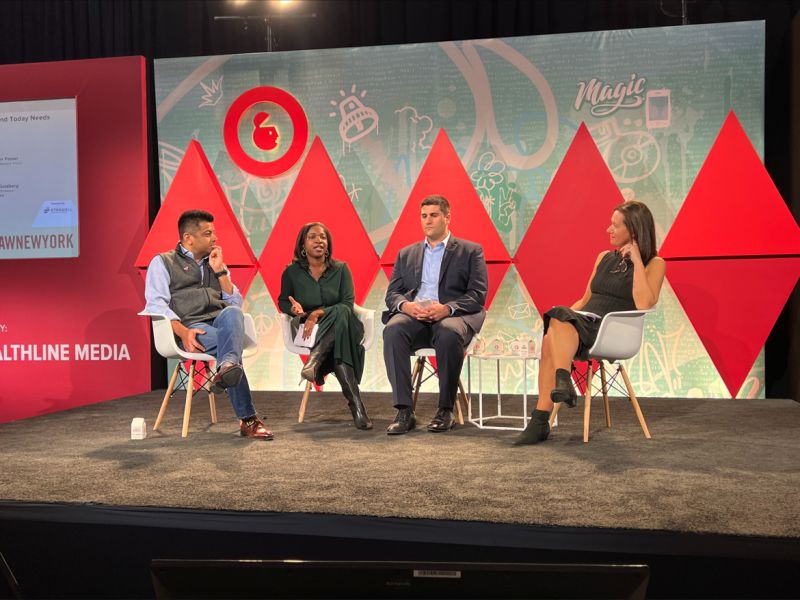
  • Talk Politics to Me: Why Every Brand Today Needs a Dose of Political Know-How– Thursday 10/20 @ 1:15p:  Political is THE media story of Q4 2022, and it’s never been a more critical time for all advertisers to know the rules of the game.  Join Assembly, a global omnichannel media agency – with an only-of-its-kind full-service political strategy and media practice – and experts from Lyft and SambaTV for a discussion on the path forward for brands in a politically charged media environment and the convergence of political, advocacy, and commercial advertising.  

Also at Advertising Week New York:  

In addition to staged programming, Stagwell is proud to partner with Brand Innovators to deliver access to intimate thought leadership with leading CMOs and agency experts. Sign up to follow along with insights and other content from Advertising Week New York.  

About Stagwell 

Stagwell is the challenger network built to transform marketing. We deliver scaled creative performance for the world’s most ambitious brands, connecting culture-moving creativity with leading-edge technology to harmonize the art and science of marketing.  Led by entrepreneurs, our 13,000+ specialists in 34+ countries are unified under a single purpose: to drive effectiveness and improve business results for their clients. Join us at www.stagwellglobal.com. 


Newsletter

Sign Up