
By: Ray Day
CONTACT:
We wanted to share our latest consumer and business insights, based on research from Stagwell. Among the highlights of our weekly consumer sentiment tracking (fielded Feb. 10-12):
WORRIES ABOUT ECONOMY JUMP:
Today, 90% of Americans are concerned about the economy and inflation – up 5 points from last week and up sharply from 82% in December.
- 84% worry about U.S. crime rates (up 6 points)
- 82% about a potential U.S. recession (up 2 points)
- 75% about affording their living expenses (up 5 points)
- 75% about political divisiveness (up 3 points)
- 72% about the War on Ukraine (up 2 points)
- 55% about a new COVID-19 variant (down 2 points)
- 47% about losing their jobs (up 2 points)
WHEN SHOULD COMPANIES SPEAK OUT?:
Following the State of the Union (SOTU) address, we surveyed Americans to pinpoint their views on the buy-American theme as well as to update our past research on companies “speaking out” on social issues. We found strong views on both.
“Made in America”
- Nearly three-quarters (73%) of Americans say they often seek American-made products and brands when shopping (up 1 point from July 2022), especially true among those who watched some or all of the SOTU.
- Regarding intentionally purchasing American-made products and brands, 71% report doing so a little bit or a lot.
- 53% have shopped for an American-made product in the last month.
- 76% of Americans agree that there should be more American-made products and brands available in the U.S.
- 76% agree that brands need to make more products in the U.S. (up 1 point from July 2022).
- 56% would be willing to pay more for a product if they knew it was American made.
- However, 45% believe that American-made products already are too expensive.
“Speaking Out in America”
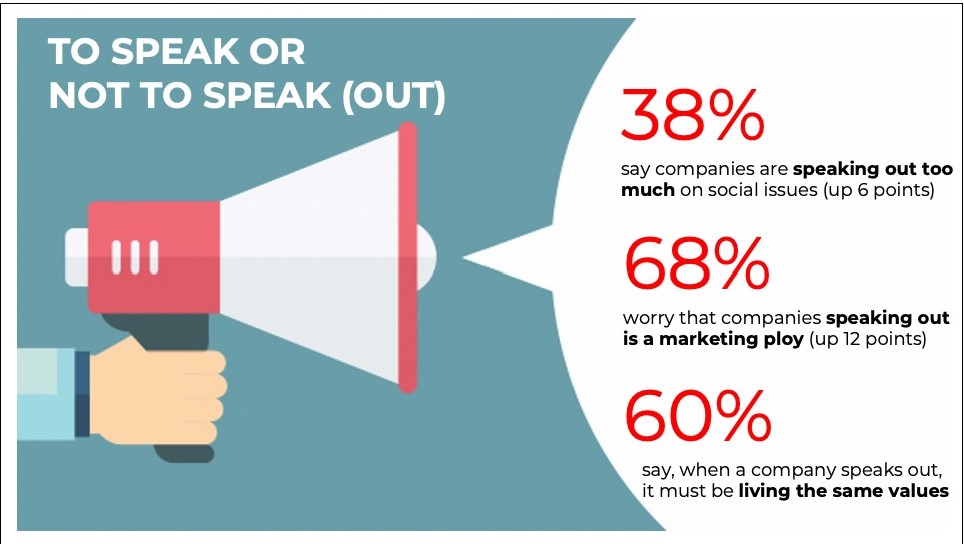
- A third of Americans (38%) think that American companies are speaking out too much on social issues (up 6 points from July 2022).
- 37% believe companies are speaking out the right amount (down 3 points from July 2022), while 25% believe they aren’t speaking out enough (down 3 points).
- 68% of Americans think that, when companies voice their opinion on a social issue, it’s a marketing ploy (up 12 points from July 2022).
- When companies are speaking out on social issues, 71% of Americans agree that a company’s history on social issues is important.
- 60% agree that when a company speaks out on social issues, it must be supported by living their internal company values.
- More Americans believe that there is generally more risk (59%) to a CEO speaking out on social issues (up 5 points from April 2022) than reward (41%).
- Democrats (55%) are more likely to believe there is more reward in a CEO speaking out than Republicans (33%).
- Americans also believe that CEOs expressing their own political views is bad for the company (47%, up 5 points from April 2022), more so than good.
TRAVEL TRENDS FOR THE NEXT DECADE:
During the next three years, nearly 2 billion people will travel at least once a year – making the travel and hospitality industry continually attractive. Yet what does the future hold? Stagwell’s Northstar partnered with travel technology company Amadeus on new research defining four new types of travelers – in a report titled Traveler Tribes 2033 – who will emerge in the next decade along with suggestions on what brands need to do to create relevant travel experiences for them.
- Excited Experientialists:
- 44% are without children and have a mid- to high-income job with flexible working options, which enables them to readily explore the world. They are more likely than other travelers to act on instinct, making them “anti-planners” and favoring less predictable and more exciting accommodation experiences. They also are open to technology like the use of artificial intelligence in the airport environment.
- Memory Makers:
- 44% are ages 42 and older and are habitual in their travel behaviors. They put people first and place less value on technology and sustainability, reassured by existing methods. Despite their skepticism about technology, they are excited about virtual reality and augmented reality preview tours before purchasing a trip.
- Travel Tech-fluencers:
- 48% of the group are under the age of 32, and their perspective is symbolized by how much technology they own. While many want to travel sustainably, they are more conscious about sustainability options around their method of travel, rather than where they’ll be staying.
- Pioneering Pathfinders:
- 82% are between the ages of 23 and 41. They like to plan but are not afraid of risk and are open to new experiences. This group is more willing than others to let sustainability influence their decisions. They will be very comfortable using all forms of alternative payment methods – whether cryptocurrency or within a virtual reality environment.
EMPLOYEES AND HR DISAGREE ON RACIAL EQUITY PROGRESS:
Our new State of Inequity report with Hue illuminates wide disparities along racial lines in workplace opportunity, compensation and experience in a post-pandemic labor market.
- More than 200,000 Black and Latina women have disappeared from the workforce since the pandemic’s beginning. Many have stopped looking for new jobs, making them invisible to unemployment statistics and ineligible for federal benefits.
- Most BIPOC employees report their employer has not instituted racial awareness training (82%) nor have they increased recruiting efforts toward racially diverse hiring (81%).
- A gap exists between HR and employees: 84% of BIPOC employees report their company has not addressed the mental/emotional impact of discrimination on its employees of color since June 2020. At the same time, 91% of HR professionals surveyed say the various diversity-related initiatives their companies have implemented are effective.
- One in four BIPOC women report not being paid fairly and in a comparable way to other colleagues at their level across their company.
- BIPOC women are twice as likely not to be paid fairly and in a comparable way to other colleagues across their company compared to white men.
- Two in Five BIPOC women reported feeling exhausted or burned out last year because of their workplace.
- BIPOC women are twice more likely to report they have felt fatigued related to racial tension or issues at work in the last six months compared to white men.
- More BIPOC women are not comfortable being fully themselves at work, twice as likely compared to white men.
- Even in the face of workplace hardships, BIPOC women are investing in themselves. Nearly twice as many BIPOC women (45%) report gaining new skills or education to become a more competitive job candidate compared to white Americans (27%).
ICYMI:
In case you missed it, check out some of the thought-leadership and happenings around Stagwell making news:
- Vast Majority of Americans Prefer In-Person Job Interviews vs. Virtual
- Exploring the future of money
- The high price of being single: ‘It’s all on one person’
- Americans With Trouble Sleeping Report Their Sleep Affects Their Relationships
As always, if helpful, we would be happy to provide more info on any of these data or insights. Please do not hesitate to reach out.
Thank you.
Related
Articles
In the News, Press Releases, Talent & Awards
Sep 15, 2026
Code and Theory Honored by Fast Company’s Innovation by Design for Four Consecutive Years
In the News, Press Releases, Talent & Awards
Sep 15, 2026
Stagwell Strengthens Assembly Leadership with Two Key CEO Appointments


Newsletter
Sign Up

By: Ray Day
CONTACT:
We wanted to share our latest consumer and business insights, based on research from Stagwell. Among the highlights of our weekly consumer sentiment tracking (fielded Feb. 3-5):
WORRIES ABOUT JOB LOSSES JUMP:
Today, 85% of Americans are concerned about the economy and inflation – down 2 points from last week and up from 82% in December. Concerns about job losses, however, are on the rise.
- 80% worry about a potential U.S. recession (down 2 points)
- 78% about U.S. crime rates (down 3 points)
- 72% about political divisiveness (down 3 points)
- 70% about affording their living expenses (up 4 points)
- 70% about the War on Ukraine (up 1 point)
- 57% about a new COVID-19 variant (down 1 point)
- 45% about losing their jobs (up 3 points)
18% OF GEN Z WOULD BE HAPPY TO BE LAID OFF:
“Laid off and loving it” is the mood of a small but vocal group of employees caught in the job cuts roiling firms from Wall Street to Silicon Valley, according to our survey with Bloomberg.
- 18% of Gen Z and 15% of Millennial employees say they would be happy being laid off, more so than their older colleagues (Gen X: 8%, Boomers: 6%).
- Overall, one in 10 employees say they would feel thankful (9%), relieved (10%) and happy if laid off today (12%).
- Of those who experienced a layoff in the last year, 42% spent more time with friends and family, on their hobbies (28%) and their physical (26%) and mental health (29%).
- Most employed Americans (43%) say that, if they were laid off today, they would find another job within three months. Yet that changes across generations, with Boomers (28%) less likely to think so than Gen Z (43%), Millennials (48%) or Gen X (47%).
CHILDCARE SPENDING HAS ITS LIMITS:
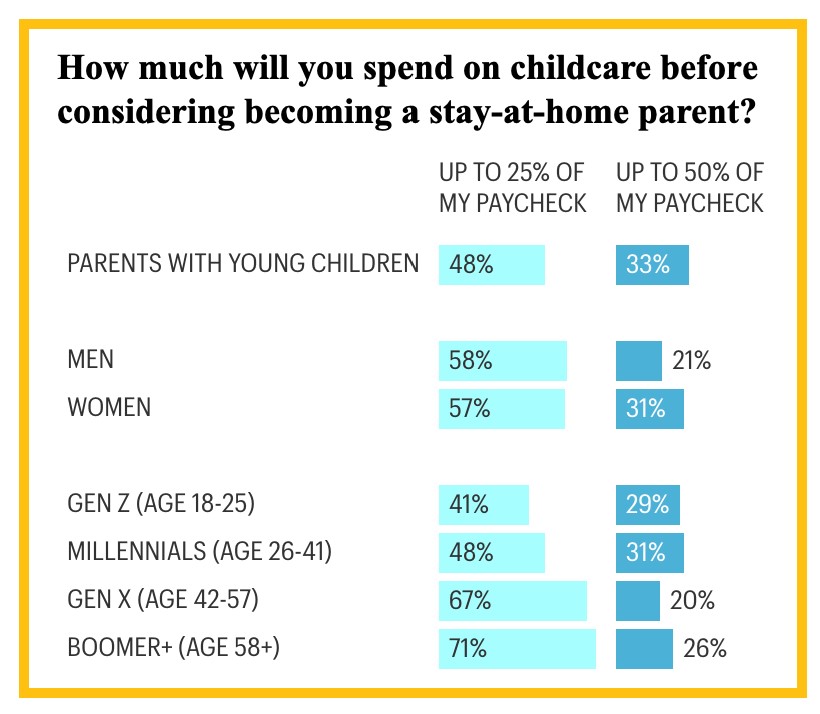
How much are you willing to spend on childcare before it no longer makes sense to work? Most Americans say an average of $617 a month is fair. Yet, if childcare costs eat away a quarter of their paycheck or more, nearly half of parents with young children under the age of 5 would consider being a stay-at-home parent, according to our survey with Fortune.
- On average, U.S. families spend an average of 17.8% of their income on childcare.
- Younger workers are more willing than older Americans to pay more for childcare. And fathers are willing to spend about $100 more per month than mothers ($668 versus $568).
- More than a third of stay-at-home parents say they left their jobs to care for their children because of financial difficulties in affording childcare (19%) or limited childcare availability (17%).
- Among former and current stay-at-home parents, 36% say they felt forced into leaving the workforce to care for their children.
- 87% of Americans say they would continue working if childcare was more accessible – with high agreement across all age groups.
- 52% of stay-at-home parents with children under the age of 5 believe their careers have been negatively affected by that choice.
- 68% of both men and women believe mothers are penalized more in the workforce after staying home to care for children.
MORE TRUST CONCERNS ABOUT AI:
Americans rely on artificial intelligence to inform everyday consumer choices like movie recommendations and customer service inquiries, yet they draw the line when it comes to trusting AI for high-value applications, such as autonomous vehicles, accessing government benefits and healthcare. Our survey with MITRE also found:
- 48% of Americans believe AI is safe and secure.
- 78% are very or somewhat concerned that AI can be used for malicious intent.
- 82% of Americans and 91% of tech experts support government regulation.
- 70% of Americans and 92% of tech experts agree that there is a need for industry to invest more in AI assurance measures to protect the public.
- Three-quarters of Americans are concerned about deepfakes and other AI-generated content.
- Only 49% would be comfortable having an AI-based online chat for routine medical questions.
- Similarly, only 49% would be comfortable with the federal government using AI to assist benefits processing.
ESG INVESTOR INTEREST GROWS
Most investors are interested in ESG and want their advisors to show them the path forward, based on our survey with Nuveen.
- 75% of investors older than 21 with at least $100,000 in investable assets see their company ownership as a way to get businesses to address ESG-related risks and opportunities.
- 57% would be interested in shifting their portfolios to invest only in companies with net-zero emissions.
- 80% said that companies should be more transparent about ESG issues.
- 73% said they would be more likely to invest in businesses that are open about their plans for addressing those factors.
- Last year’s findings from the 2022 Milken Institute Harris Poll Listening Project found that 68% of executives said their company has as much as a quarter of their portfolio dedicated to ESG investments. Yet 32% said their companies lack ESG investments entirely.
ICYMI:
In case you missed it, check out some of the thought-leadership and happenings around Stagwell making news:
- ‘Funny,’ ‘light-hearted’ and ‘unique’ are top qualities the public wants in Super Bowl ads
- Building brand fandom at the Super Bowl
- Pandemic Pushes Planned Retirement Age by 3 Years
- Gen Z and Millennials Accept Online Creeping and Stalking as Part of Dating Culture
- Stagwell’s Instrument opens applications for 2023 pro bono program supporting black and systemically excluded communities
As always, if helpful, we would be happy to provide more info on any of these data or insights. Please do not hesitate to reach out.
Thank you.
Related
Articles
In the News, Press Releases, Talent & Awards
Sep 15, 2026
Code and Theory Honored by Fast Company’s Innovation by Design for Four Consecutive Years
In the News, Press Releases, Talent & Awards
Sep 15, 2026
Stagwell Strengthens Assembly Leadership with Two Key CEO Appointments
Newsletter
Sign Up
Launched in 2020, the Program is Built to Serve Organizations Supporting Black and Systemically Excluded Communities
NEW YORK and PORTLAND, Ore., Feb. 8, 2023 /PRNewswire/ — Instrument, a leading digital agency within Stagwell (NASDAQ: STGW), opened applications today for its Build. Grow. Serve. (BGS) pro bono program, an ongoing $3 million agency commitment to support and empower Black and systemically excluded communities. Applications are open at this link. The program includes three tenets:
- Build, in which Instrument donates hours of design, strategy and development work to nonprofit organizations
- Grow, Instrument’s donation matching initiative, which to date has contributed over $355,000 to organizations advancing equity
- Serve, a volunteer time-off benefit, affording each Instrument employee 16 hours of paid time off per year to volunteer with nonprofits of their choosing
Instrument seeks applications from organizations that are working to support Black & systemically excluded communities.

Instrument seeks applications from organizations that are working to support Black and systemically excluded communities, fight prejudice, or pursue a more just and inclusive future. Selected organizations will receive pro bono support from Instrument, including strategy, creative, and technology services, to accelerate the impact their organizations are delivering to these communities. The partnership will culminate in a completed project by the end of 2023.
“Our Build. Grow. Serve. program is foundational to who we are at Instrument – and representative of how we think all companies need to show up in today’s world,” said Kara Place, CEO, Instrument. “Our partnerships with organizations that are actively making the world a better place allow us to amplify their work and mission, and provide opportunities for our employees to use their skills in meaningful ways.”
In 2022, the program supported BlackSpace, a collective or urbanists, architects, policymakers, artists, and advocates co-creating spaces that affirm and amplify Black presence in public spaces. During the partnership, Instrument created an evolved brand, design system, and a reimagined digital experience that empowers the organization to scale its mission.
“We can’t believe our eyes – the final results are beyond what we could’ve imagined. Instrument has given us something really special, and we’re so happy with all the hard work of everyone involved,” said BlackSpace Co-Managing Director Emma Osore. “The attention to creating approachable language and guides, providing updates at every turn, and sensitivity to our budget were especially generous touches that did not go unnoticed and were highly appreciated.”
Work completed for Instrument’s inaugural BGS partner, BankBlackUSA, a grassroots organization with a mission to promote financial advocacy in Black communities, was recognized in Fast Company’s 2022 Innovation by Design Awards across three key categories: Finance, Graphic Design and Impact.
To apply for the 2023 BGS program, complete this short application form , outlining your organization’s mission, goals, and the type of support needed. Applications will close Wednesday, March 10. For questions about the application, please contact Shanelle Felice, Associate Director, Business Development and Build. Grow. Serve co-lead at shanelle.felice@instrument.com.
About Instrument
Instrument is a values-driven digital agency with offices in Portland, Oregon, Brooklyn, New York, and Los Angeles, California. We are a dynamic group of creative technologists and storytellers that use the power of design and technology to co-create groundbreaking work with our clients. We connect brands like never before—helping organizations reimagine the most valuable pieces of their digital ecosystem. With deep talent in the areas of Strategy, Design, Development and Content Creation, we build modern experiences for ambitious brands.
About Stagwell
Stagwell is the challenger network built to transform marketing. We deliver scaled creative performance for the world’s most ambitious brands, connecting culture-moving creativity with leading-edge technology to harmonize the art and science of marketing. Led by entrepreneurs, our 13,000+ specialists in 34+ countries are unified under a single purpose: to drive effectiveness and improve business results for their clients. Join us at www.stagwellglobal.com.
Contact: Brandon Dixon; pr@stagwellglobal.com
SOURCE Stagwell Inc.
Related
Articles
In the News, Press Releases, Talent & Awards
Sep 15, 2026
Code and Theory Honored by Fast Company’s Innovation by Design for Four Consecutive Years
In the News, Press Releases, Talent & Awards
Sep 15, 2026
Stagwell Strengthens Assembly Leadership with Two Key CEO Appointments
Newsletter
Sign Up
Insights Rooted in New Whitepaper from NRG, “Building Brand Fandom at the Super Bowl”
NEW YORK and PHOENIX, Feb. 8, 2023 /PRNewswire/ — Research from Stagwell‘s (NASDAQ: STGW) National Research Group (NRG), a global insights leader at the intersection of technology, content, and culture, proves the value for brand activation at major sporting events like the Super Bowl in its newest whitepaper, “Building Brand Fandom at the Super Bowl.” In the report, NRG outlines “the anatomy of a fan” by analyzing Super Bowl fans and non-Super Bowl fans’ responses to questions around their excitement for the game, the advertisements, viewing habits, social media consumption, perceptions of the brands involved, and more.
“We encourage brands to think about the massive potential of cultural moments like these as driving forces for business.
The whitepaper is the second iteration of NRG’s “Brand Fandom” platform in the lead up to Stagwell’s Sport Beach activation at Cannes 2023, tapping into the cultural zeitgeist of sport to unpack the journey to fandom across key categories and audiences, and the value for brands in making fans out of their communities.
“There’s no question the Super Bowl is a pinnacle of culture-moving sports events, drawing everyone from committed NFL fans to passive viewers looking to be entertained,” said NRG EVP, Brand Strategy and Innovation, Fotoulla Damaskos. “In this installment of our research, we proved our hypothesis that the same attributes that draw people to sports – community, creativity, exclusivity – are the same ones that drive brand fandom. We encourage brands to think about the massive potential of cultural moments like these as driving forces for their business.”
“There are few events that command such an energized fan base as the Super Bowl, and combined with the buzz before, during, and after a big sporting event, it’s a no-brainer for brands to become part of the conversation if they want to harness that kind of deeply rooted passion for their own brand,” said Stagwell EVP, Chief Marketing Officer Ryan Linder.
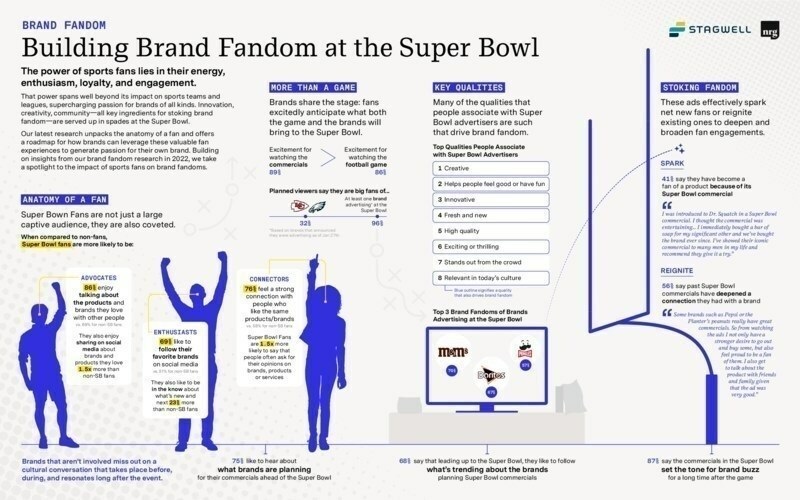
Research found that when compared to non-fans, Super Bowl fans are more than just a large captive audience. They are coveted, as they are more likely to be:
- Advocates: 86% enjoy talking about the products and brands they love with other people (vs. 69% of non-SB fans) and are 1.5x more likely to share on social media about brands and products they love than non-SB fans.
- Enthusiasts: 85% like to be in the know about what’s new and next (vs. 62% of non-SB fans), and 69% like to follow their favorite brands on social media (vs. 51% for non-SB fans).
- Connectors: 76% feel a strong connection with people who like the same products/brands that they like (vs. 58% of non-SB fans) and are 1.5x more likely to say that people often ask for their opinions on brands, products, or services.
Added Highlights
- Of those who plan to watch, 96% say they are a big fan of at least one brand advertising at the Super Bowl – much greater than those who say they are big fans of either the Kansas City Chiefs or the Philadelphia Eagles (32%).
- Fans are just as excited to watch the commercials (89%) as they are the game itself (86%) and the halftime show (85%).
- 87% say the commercials in the Super Bowl set the tone for brand buzz for a long time after the game.
- 41% say they have become a fan of a product because of its Super Bowl commercial.
- 56% say past Super Bowl commercials have deepened a connection they had with a brand.
Brand Innovators Sports Marketing Upfronts
Ahead of the Big Game, the research will take center stage at the “Anatomy of a Fan: Building Brand Passion” panel today, hosted by Brand Innovators and taking place at 10:50 a.m. MST at Hotel Valley Ho. Brand leaders and marketing experts, including Stagwell’s Linder and NRG’s Damaskos, Diageo Senior Vice President of Whiskeys Portfolio in North America Sophie Kelly, and United Airlines Managing Director, Global Sponsorships and Inclusive Partnerships Jennifer Entenman, will answer questions such as:
- How are you harnessing fan power to keep consumers engaged with your brand?
- How much do experiences like the Super Bowl help brands connect to new audiences?
- How can brands continue to leverage and build upon buzz even after the Super Bowl?
To attend the panel and other programming, please register with Brand Innovators here. NRG introduced the research platform at Advertising Week 2022 with “The Power of Brand Fandom.”
Methodology
Data used in this report comes from a study of 1,003 US consumers, ages 18 to 65, conducted from Jan. 27-30, 2023, representative of the national population in terms of age, gender and ethnicity.
About National Research Group
National Research Group is a leading global insights and strategy firm at the intersection of entertainment and technology. Rooted in four decades of industry expertise, the world’s leading marketers turn to us for insights into growth and strategy for any content, anywhere, on any device. Working at the confluence of content, culture and technology, NRG offers insights for bold storytellers everywhere. To learn more, please visit www.nationalresearchgroup.com, and follow us on LinkedIn and Instagram.
About Stagwell
Stagwell is the challenger network built to transform marketing. We deliver scaled creative performance for the world’s most ambitious brands, connecting culture-moving creativity with leading-edge technology to harmonize the art and science of marketing. Led by entrepreneurs, our 13,000+ specialists in 34+ countries are unified under a single purpose: to drive effectiveness and improve business results for their clients. Join us at www.stagwellglobal.com.
Media Contact
Sarah Arvizo
pr@stagwellglobal.com
SOURCE Stagwell Inc.
Related
Articles
In the News, Press Releases, Talent & Awards
Sep 15, 2026
Code and Theory Honored by Fast Company’s Innovation by Design for Four Consecutive Years
In the News, Press Releases, Talent & Awards
Sep 15, 2026
Stagwell Strengthens Assembly Leadership with Two Key CEO Appointments
Newsletter
Sign Up

Industry Veteran Joins Growth Team Led by Global CMO Ryan Linder
NEW YORK and LONDON, Feb. 7, 2023 /PRNewswire/ — Stagwell (NASDAQ: STGW), the challenger network built to transform marketing, has appointed Helen Lafford as senior vice president, chief growth officer for the United Kingdom (U.K.) and Europe. Based in London, Helen will help shepherd international growth for the network, with the goal to spearhead cross-agency new business development in the region.
“I’m delighted to join the most transformational and forward-thinking team in marketing.”
A 25-year industry veteran, Helen joins from global media agency Initiative, where she served as EMEA head of growth and led wins across major reviews including Nike EMEA, Arla, ING, Amazon, and AstraZeneca, spurring record-setting growth for the agency. Prior to that, Helen represented Publicis Groupe’s Blue 449 advertising agency on the founding team of Project Everyone, a nonprofit creative communications agency, providing global media support for the announcement of the 2015 United Nations Global Development Goals. She went on to serve as Blue 449’s global head of special projects prior to joining Initiative. And previously she was Business Director at Mindshare Worldwide, where she managed a wide portfolio of accounts from IBM, Nestlé, Mondelez, Kimberly Clark EMEA, Zegna and the global Rolex account.
“I love the diverse and exhilarating industry we work in and I’m delighted to join the most transformational and forward-thinking team in marketing as Stagwell’s Chief Growth Officer for U.K./Europe,” said Lafford. “As Stagwell continues to expand and evolve its global remit, placing a dedicated focus and emphasis on the markets and regions, I am excited to work with a proven Growth Team and an illustrious roster of successful brands to further bring Stagwell U.K./Europe to life.”
“Beyond Helen’s stellar track record of landing and scaling some of the world’s most revered brands, she has the qualities that define the best leaders within our network: gracefully assertive, motivated by opportunity, supportive of our internal cultures, and a complementary partner,” said Stagwell EVP, Chief Marketing Officer Ryan Linder. “We’re excited for her leadership as we expand in Europe and the U.K.”
There are more than 2,000 employees in the Stagwell network across the U.K. and Europe, at agencies including 72andSunny, Allison + Partners, Anomaly, Assembly, Brand New Galaxy, Code and Theory, CPB London, Concentric, Forsman & Bodenfors, GALE, Goodstuff, Hunter, Ink, KWT Global, Locaria, National Research Group, and Northstar.
About Stagwell
Stagwell is the challenger network built to transform marketing. We deliver scaled creative performance for the world’s most ambitious brands, connecting culture-moving creativity with leading-edge technology to harmonize the art and science of marketing. Led by entrepreneurs, our 13,000+ specialists in 34+ countries are unified under a single purpose: to drive effectiveness and improve business results for their clients. Join us at www.stagwellglobal.com.
SOURCE Stagwell Inc.
Related
Articles
In the News, Press Releases, Talent & Awards
Sep 15, 2026
Code and Theory Honored by Fast Company’s Innovation by Design for Four Consecutive Years
In the News, Press Releases, Talent & Awards
Sep 15, 2026
Stagwell Strengthens Assembly Leadership with Two Key CEO Appointments
Newsletter
Sign Up
By
By: Brandon Dixon, Director, Communications
CONTACT
hello@stagwellglobal.com
SIGN UP FOR OUR INSIGHTS BLASTS
The success of “Black Panther: Wakanda Forever” at the end-of-2022 box office sparked a question at Stagwell: “When is Black Futures Month?” Brands flocked to the marketing table for the Black Panther sequel, and for good reason: in a 2020 study from National Research Group 52% of Black Americans selected the original film as the “best example of representation and inclusion” in American entertainment. But, marketers still rely too much on Black History Month as the main chance to elevate Black stories.
The success of “Wakanda Forever” shows we should focus on Black futures, not just history, in our marketing efforts. As brands and entertainment converge, how can we drive complex representation for Black consumers and tap into growth opportunities?
Multi-Dimensional Blackness
Despite an increase in Black characters and stories in mainstream media, authentic and complex representation is still lacking. 91% of Black Americans still see negative stereotypes as a top pain point. Brands can challenge these narratives through speculative storytelling and Afrofuturism, offering new contexts for Black characters.
Investing in sci-fi, fantasy, or superhero genres can be a potential goldmine for brands. The 2020 National Research Group study shows Black Americans praised “Black Panther” and “Black Lightning” as the best examples of authentic Black representation in American media. These two shows showcase the potential growth in futuristic, fantastical genres that bring Blackness to the masses. The study also found that 77% of American consumers and 85% of Black Americans find Black content in a futuristic setting appealing.
Future-Forward Creativity
Brand creativity that only mines the past for visions of Blackness may dwell on traumatic storylines. Joy exists in the past, but clumsy brand storytelling often leads to the platforming of the same recurring stories about Black oppression. If brands can build Future narratives in concert with Black creatives and think expansively about the potential forms Blackness might take in the future, we’ll see more stories of Black joy and transcendence enter the mainstream.
Potential for Transformation
Ninety-one percent of consumers are confident in the ability of media to influence society, per the 2020 National Research Group study cited above. As brands blur the line between Hollywood and Madison Avenue with branded entertainment, future-leaning visions are the way forward to connect meaningfully with Black consumers.
Let’s use Black Futures Month to challenge our brands to think about what’s next.
What kind of Black Future can your brand imagine, and help create?
Related
Articles
In the News, Press Releases, Talent & Awards
May 12, 2026
Stagwell Media Platform Appoints Dru Sil to Global Product Managing Director

In the News, Press Releases, Talent & Awards
Apr 10, 2026
Stagwell (STGW) Appoints Nicole Souza as Chief Growth Officer, North America to Accelerate Enterprise Momentum

Artificial Intelligence, Artificial intelligence, In the News, Marketing Frontiers, Press Releases, Stagwell Marketing Cloud
Apr 06, 2026
HarrisQuest Launches Lou, a Voice-Enabled AI Analyst Built Inside The Harris Poll’s Brand Tracking Platform

Newsletter
Sign Up
Former CCO of the Virgin Group brings decades of communications experience and expertise to lead Stagwell’s Risk & Reputation practice; joins Sloane as Senior Managing Director –
NEW YORK – Feb. 3, 2023 – Stagwell (NASDAQ: STGW), the challenger network built to transform marketing, and Sloane & Company (“Sloane”), a Stagwell company and an industry leader at the forefront of corporate and financial communications, have appointed Nick Fox as Stagwell’s new head of the company’s recently launched Risk and Reputation Unit. In his combined role at both companies, Fox will serve as senior managing director for Sloane.
Fox assumes his new role after a 14-year tenure at The Virgin Group, where he served as the company’s director of external relations, and, later, chief communications officer—overseeing the growth and protection of Virgin’s brand around the world. In addition to advising CEOs across Virgin’s partnerships in mobile, travel, health, space, and other sectors, Fox also managed the rollout of Virgin Galactic’s initial public offering in 2019 and that of Virgin Orbit in 2021. Following his departure from Virgin in December 2021, Fox has continued to provide strategic communications counsel for a range of clientele, with a primary focus on brand building, risk management and corporate reputation.
“Nick is an incredible addition to the Stagwell team,” said Stagwell Chairman and CEO Mark Penn. “He brings a wealth of global communications knowledge – working at the senior-most levels of international business. Our Risk and Reputation business unit has already curated an impressive slate of experts to tackle the most sensitive issues facing business leaders today. I am confident that with Nick at the helm, this practice will continue to drive immense value and top-notch guidance for our clients and their stakeholders.”
As head of the Risk and Reputation Unit, Nick will advise clients on how to manage some of the most complex business issues facing companies now, from increasing geopolitical tensions to financial system pressure to political and social polarization.
“Fox’s extensive communications background in both the U.K. and European markets poises both Stagwell and Sloane to broaden their international reach to attract new business—while also bringing a fresh perspective to existing client work,” added Sloane & Company CEOs Darren Brandt and Whit Clay. “As more companies seek trusted communications partners that will get into the weeds with them and help them navigate the travails of the U.S. market—or perhaps gain access to it for the first time—we are confident that Nick’s unique skillset will position us for impressive growth and client success, both now and in the long-run.”
“The expert roundtable that Stagwell and Sloane are building represents a deep knowledge base that you don’t find in a traditional communications firm,” said Nick Fox. “The opportunity to engage with and draw from the corporate, financial, and political arenas will provide an extremely valuable service for global leaders and companies facing increasingly complex challenges today. I am looking forward to working with such an entrepreneurially minded group.”
Fox began his new position in February, splitting his time between New York City and Washington, D.C.
Related
Articles
In the News, Press Releases, Talent & Awards
Sep 15, 2026
Code and Theory Honored by Fast Company’s Innovation by Design for Four Consecutive Years
In the News, Press Releases, Talent & Awards
Sep 15, 2026
Stagwell Strengthens Assembly Leadership with Two Key CEO Appointments
Newsletter
Sign Up
By: Ray Day
CONTACT:
We wanted to share our latest consumer and business insights, based on research from Stagwell. Among the highlights of our weekly consumer sentiment tracking (fielded Jan. 27-29):
ECONOMIC WORRIES MIXED:
Today, 87% of Americans are concerned about the economy and inflation – up 1 point from last week and up from 82% in December.
- 82% worry about a potential U.S. recession (down 1 point)
- 81% about U.S. crime rates (up 1 point)
- 75% about political divisiveness (up 4 points)
- 69% about the War on Ukraine (up 1 point)
- 66% about affording their living expenses (down 5 points)
- 58% about a new COVID-19 variant (down 2 points)
- 42% about losing their jobs (down 7 points)
PARENTS WANT CHILDCARE SUPPORT AT WORK:
Parents increasingly feel unsupported in the workplace and expect more childcare support from employers and the government, based on our new Parent Confidence Report with KinderCare.
- 61% of working parents say there is a disconnect between the level of support they need and the benefits their employer provides.
- Childcare benefits are the second most important reason for parents staying at their current job – with 18% ranking them as the most crucial benefit – behind health insurance.
- More than half of working parents would stay at their current job if their employer provided childcare benefits, such as pre-tax benefits, emergency/backup childcare and on-site childcare.
- 70% of parents say childcare is at a crisis point in terms of accessibility and affordability.
- 66% believe the government should offer universal childcare to all children, from birth to kindergarten.
1 IN 10 LOOKING FOR NEW HOME, BUT WITH UNREALISTIC PRICE EXPECTATIONS:
For the fifth year in a row, most Americans (83%) say buying a home is a priority. Yet, in our latest survey with NerdWallet, high mortgage rates and a seller-friendly housing market prove to be obstacles – along with unrealistic home price expectations.
- 11% of Americans say they plan to buy a home in the next year.
- Prospective buyers hope to spend $269,200 on average. This is significantly lower than the typical home price of $379,100.
- 32% of Americans feel worse about their ability to purchase a home in 2023 than in 2022 (a 7-point increase from last year).
- The top reasons for the more negative outlook include a worsening economy (58%), higher mortgage rates (57%) and higher home prices (57%).
- 67% of Americans say a housing market crash is imminent in the next three years.
INVESTORS RETHINK RETIREMENT PLANS:
Turbulent market conditions and rampant inflation have forced investors to consider working after retirement, based on our survey with Nationwide.
- 69% of non-retired investors say post-retirement employment could lie ahead.
- 44% of these investors inclined to keep working say they’ll have to supplement their retirement savings or income out of necessity.
- 40% of non-retired investors plan to move to a different city or region after retiring, with the most common reasonings being lower cost of living (43%) and lower taxes (34%) – far ahead of being closer to family (22%).
- 49% of non-retired investors with a financial advisor are “very nervous” about spending down their retirement savings in today’s current market environment.
LACK OF TRUST OVERSHADOWS NEW AI TOOLS:
Businesses might need to slow their roll when it comes to adopting AI tools like ChatGPT and DALL-E2, according to our latest study with AdAge.
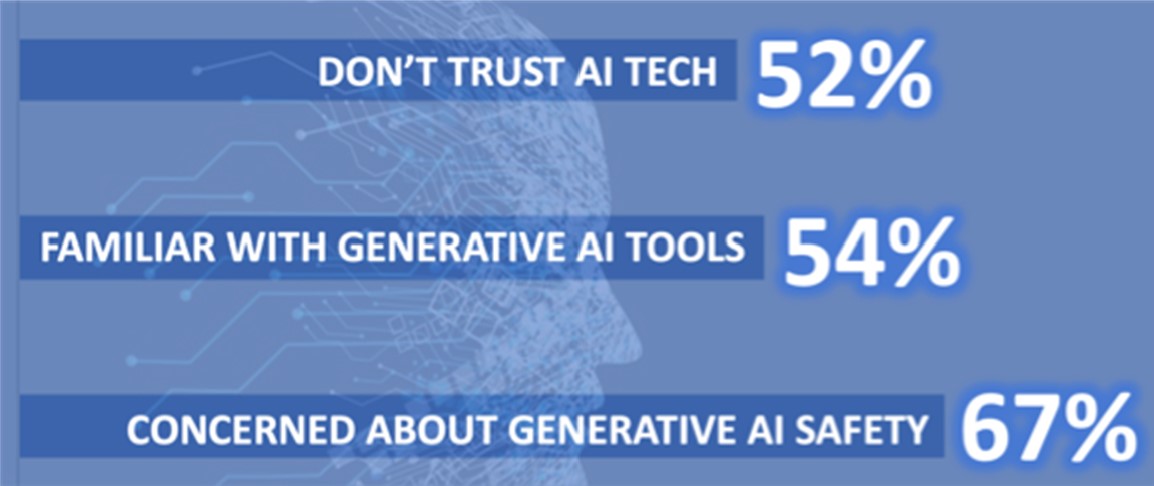
- 52% don’t trust AI tech.
- 54% are familiar with generative AI tools, and nearly a fifth have used one.
- 67% of Americans are concerned about the safety of generative AI technology.
- Only 29% said they have not used generative AI nor are they interested in doing so.
- Less than half (44%) say that it is easy to tell the difference between something created by AI and something created by a human.
- 58% think things created by generative AI tools are less impressive than things created by people.
ICYMI:
In case you missed it, check out some of the thought-leadership and happenings around Stagwell making news:
- Five Things to Know About ChatGPT
- Generative AI – how marketers should navigate consumer distrust
- Augmented reality. The bright future of women’s sports. What Gen Z wants from work. Stagwell’s National Research Group explores all of these topics in a new premium magazine, Boundless.
- 20 brands gaining popularity with Gen Z
- About three-quarters of people who plan to watch the Super Bowl said they’re excited for the ads
- Big Tech’s Free Ride Is Coming to an End
As always, if helpful, we would be happy to provide more info on any of these data or insights. Please do not hesitate to reach out.
Thank you.
Related
Articles
In the News, Press Releases, Talent & Awards
Sep 15, 2026
Code and Theory Honored by Fast Company’s Innovation by Design for Four Consecutive Years
In the News, Press Releases, Talent & Awards
Sep 15, 2026
Stagwell Strengthens Assembly Leadership with Two Key CEO Appointments
Newsletter
Sign Up
By: Mark Penn
Originally Published on: Barron’s
About the author: Mark Penn is chairman and CEO of Stagwell, a technology-based global marketing services firm.
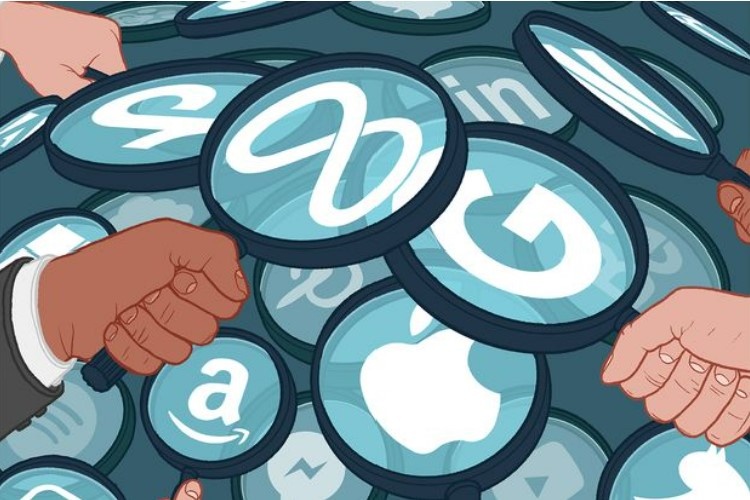
Technology’s Wild West era is coming to an end. For decades, American policy has been hands-off technology to let it grow and innovate. On the eve of the dawn of artificial intelligence and the metaverse, the bad taste consumers have of social media and its divisiveness suggests that more aggressive regulation is just around the corner.
The recent round of layoffs won’t do much to staunch consumers’ fears that technology is enabling the possibility of a surveillance state. Their concerns will accelerate movement on tech privacy, censorship, anticompetitiveness, and national security legislation in the U.S. and abroad in 2023.
Half of consumers in America fear that technology will undermine their personal freedoms over the next decade, and 70% worry that tech will give more power to big corporations. The younger generations are particularly suspicious of Big Tech. Elon Musk gave some journalists access to Twitter’s records after he bought the social company. The reports they produced, known as the Twitter Files, were a damning revelation that government officials were pulling the strings behind the curtain and that the tech companies were willingly obedient much of the time.
In a recent Harvard-Harris Poll, 70% of voters now support a national law to prevent corporate censorship. The saving grace for the tech industry may be that many Democrats believe that they have been benefiting from the censorship and will oppose such a law, not understanding that what goes around comes around. They will regret blocking this legislation when they believe that they are the ones being censored. I expect this to be a significant issue in the 2024 campaign.
If Big Brother colluding with Big Tech keeps consumers up at night, the thought of TikTok being a Trojan horse for Chinese influence and spying is catnip for Congress seeking to look tough on China. Before the close of the year, leaders let loose a rash of state-based restrictions on the use of the platform by government officials. The House banned its members and staff from downloading the app. TikTok has dozens of trends working against it: Democrats and Republicans are largely aligned on the need to curb China’s influence, the Biden administration’s negotiations with TikTok have stalled, and difficult news continues to leak that employees at TikTok have misused the app, most recently to spy on journalists. The company has said it doesn’t share data with Beijing, and it fired staff members that it said were involved in the spying incident.
Voters might be less invested in the diplomatic implications of a TikTok ban than your senator, but rest assured that if the government enacts an outright ban, consumers will be up in arms. TikTok is the fastest-growing social-media platform in the U.S. and has been taking ad-market share from its legacy competitors. Expect a compromise that allows TikTok to operate but puts restrictions on how it can use and distribute information.
Beyond the U.S., data-privacy regulations will mature in 2023, meaning that global businesses will face more severe restrictions as they do business across borders. Countries have moved to enact data-privacy regulations since the implementation of the European Union’s General Data Protection Regulation in 2018, and now more than 100 have rules in place, according to Forrester. By 2024, an estimated 75% of the world’s population will be covered under modern privacy regulations.
The good news is that businesses have tracked the “will they, won’t they” drama around Google’s plan to phase out user-tracking “cookies” long enough that they’ve found solutions to replace the tool—and have adjusted data-privacy standards. But a more bullish Federal Trade Commission, with a renewed focus on “harmful commercial surveillance and lax data security,” will mean that it isn’t time to rest on laurels. It’s unlikely that the U.S. will get a national standard like the proposed American Data Privacy Protection Act. But expect the FTC to oppose virtually any merger-and-acquisition activities in tech, even if the government loses its cases.
The impulse isn’t uniquely American. The EU is also taking anticompetitive action against tech giants with the adoption of the Digital Markets Act, which aims to curb the market power of dominant digital companies. We have yet to see alignment on comparable federal efforts in the U.S. but the FTC’s recent intervention into Microsoft’s Activision deal hints at more to come. The FTC will take on Google, too, for alleged anticompetitive practices, in September.
Big Tech remains a critical engine of economic opportunity and innovation. But once it began carrying news and political speech, the industry crossed a line that put it in politicians’ crosshairs. This eroded their traditionally loyal Republican free-market supporters as the Democrats were moving further to the left, taking on a more anti–big business flavor. The combination of these trends just may result in the first major year of regulation of the industry.
Related
Articles
In the News, Press Releases, Talent & Awards
Sep 15, 2026
Code and Theory Honored by Fast Company’s Innovation by Design for Four Consecutive Years
In the News, Press Releases, Talent & Awards
Sep 15, 2026
Stagwell Strengthens Assembly Leadership with Two Key CEO Appointments
Newsletter
Sign Up
By
By: Rafe Needleman, SVP, Technology Content, Allison+Partners
CONTACT
hello@stagwellglobal.com
SIGN UP FOR OUR INSIGHTS BLASTS
Artificial Intelligence will change your job — not in five years, not next year, but now. If you’re not 100% convinced, spend some time experimenting with ChatGPT, the conversational chatbot released into open beta by OpenAI in November 2022. ChatGPT is the first free and easy–to–use chat product based on the groundbreaking GPT 3 Large Language Model (LLM).
The product is a web-based chat system you can have a real conversation with. It is uncanny how well it constructs text output based on almost any input. It can answer questions, generate what appear to be original ideas and hold a decent conversation on any topic. It can also create plausible technical documentation, such as computer code and macros, and food recipes.
If you haven’t already tried it, you should. This technology will have a huge impact on communications, marketing and advertising. It will change your job, as much as the introduction of the internet did.
For many people, ChatGPT provides the first glimpse into what this type of AI will do for us in the future. It is both amazing and terrifying. And the revolution starts today.
Here’s what to know to get started:
1. You can use ChatGPT today to improve your productivity.
ChatGPT a great collaborator for generating ideas and outlines. Experiencing writer’s block? Ask ChatGPT to help get you going. Try “Outline an article about…” for starters.
ChatGPT is also good at getting you up to speed on new topics (Try, “Explain Kubernetes”) and summarizing meetings and complex stories: Type, “Give me the bullet points for this:” and then paste in text from a transcript or story. It can even write Excel macros and more advanced computer code. As part of your existing workflow, ChatGPT can be a great starting point. But keep in mind it can’t (yet) replace all your human skills. Keep reading for why.
2. ChatGPT lies.
ChatGPT is designed to create text that fits a linguistic model. While it is often useful and accurate, it does frequently make stuff up out of nowhere. In some instances, it gets facts completely wrong (ChatGPT seems to be convinced Russia has sent several bears into space, for example; it hasn’t!). Even if it has the correct information in its enormous corpus of knowledge, that doesn’t mean it understands it, and its output can sound completely plausible while being far off target. It’s also critical to remember ChatGPT was trained in 2021. It knows nothing about the world after that.
Simply put, you can’t trust ChatGPT for accuracy. Always verify what it gives you.
3. The field is evolving fast, and you need policies.
If you’re going to use this technology, it’s important to lay out clear guidelines as to how. For example, if you use ChatGPT to write an article for a client, does that need to be disclosed? How about if you use it to prepare social media copy? Let’s say you ask it to write a blog post optimized for a particular audience or SEO. Or maybe you just use it to get an article outline started. Is that something you need to tell stakeholders?
Communications companies have already caught flack for using generative AI to create content. Publications like CNET have used ChatGPT to write articles for months, The Associated Press has incorporated some kind of AI since 2015, and even The Washington Post employed it to help write for the 2020 Presidential Election. They are all still working out how to use it and how they should publicly disclose its use for written articles.
You must work out how you incorporate the technology into your day-to-day work in a responsible way. Make it clear how your teams should and shouldn’t use the tool, knowing its limitations and pitfalls. And make sure you communicate this to partners and customers.
4. Meet the “AI Native”
The capability of AI to generate original and useful creative work at scale will prove to be one of the foundational technologies of the 21st century. It will change how we live, work, learn and even think. The children born into this world will be “AI natives” and will understand the world of ideas in a different way from their parents. We can hope this technology will mostly be used to advance the way we learn and think, just as calculators changed our relationship with math. But we simply do not know yet how the developing brain will react to this type of machine intelligence.
One thing we do need to look out for, though, is a growing digital divide exacerbated by this technology. AI is not cheap to create or run, and some populations may just not have access to it, potentially putting them at an economic disadvantage. It will be a global challenge to create a responsible framework for the distribution of this tech.
5. Generative AI will impact your job, but it won’t kill it.
The software’s ability to create useful customized content is staggering and fundamental. It will certainly change how you work, as well as the nature of creative work at all levels and in every industry, worldwide.
However, no matter how useful (or damaging) this technology becomes, AI will always lack imagination, vision and compassion. Adapting to this new technology will not be easy, it is still only a tool, and we can use it to reinforce our best, most human qualities. It will still need you – your humanity, your personality, your perspective and your soul.
Be ready to change, adapt and embrace this new technology as another tool in your box of tricks.
Those who ignore the power of AI in communications will fall behind a skills curve. It’s something we’ve already embraced at A+P as one of the many tools we use. And we help clients navigate how to make the most out of this amazing technology. Keep following this blog and our social media feeds on LinkedIn, Twitter, and Facebook as we continue our series on the power of AI.
Disclosure: This story was written by a human.
Related
Articles
In the News, Press Releases, Talent & Awards
May 12, 2026
Stagwell Media Platform Appoints Dru Sil to Global Product Managing Director
In the News, Press Releases, Talent & Awards
Apr 10, 2026
Stagwell (STGW) Appoints Nicole Souza as Chief Growth Officer, North America to Accelerate Enterprise Momentum
Artificial Intelligence, Artificial intelligence, In the News, Marketing Frontiers, Press Releases, Stagwell Marketing Cloud
Apr 06, 2026
HarrisQuest Launches Lou, a Voice-Enabled AI Analyst Built Inside The Harris Poll’s Brand Tracking Platform
Newsletter
Sign Up